


Om Birla on CEC Gyanesh Kumar Removal: Fresh Notice to Follow Parliamentary Rules
Lok Sabha Speaker Om Birla says any fresh notice to remove CEC Gyanesh Kumar will follow parliamentary rules amid opposition protests over SIR.
 Rajeev

Om Birla Says Any Fresh Move to Remove CEC Gyanesh Kumar Will Follow Rules: What Happens Next?
The Lok Sabha Speaker's remarks have brought renewed attention to a rarely used constitutional process. As opposition parties consider another attempt to remove India's Chief Election Commissioner, the question is not merely whether a notice will be submitted, but whether it can satisfy the demanding legal requirements for removal.
NEW DELHI | OCTOBER 23, 2026
A Chief Election Commissioner cannot be removed simply because political parties lose confidence in him.
India's Constitution deliberately makes the process far more difficult.
That constitutional protection is now at the centre of an intensifying political confrontation involving Chief Election Commissioner Gyanesh Kumar, opposition parties and Parliament.
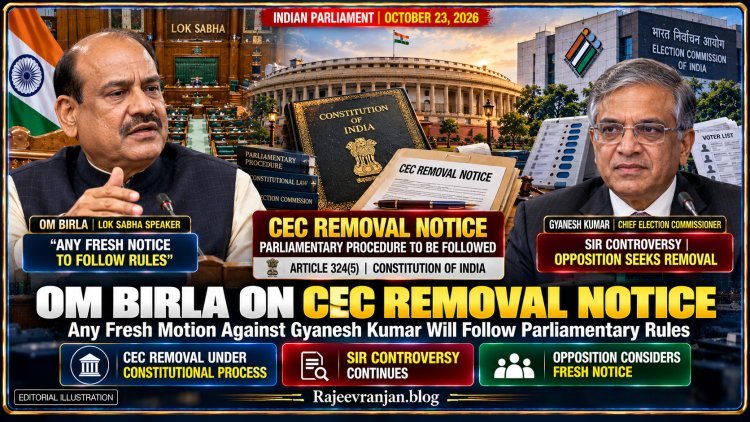
On Thursday, October 22, Lok Sabha Speaker Om Birla said that any fresh notice seeking Kumar's removal would be examined strictly according to parliamentary rules and established procedures.
Speaking to journalists in New Delhi, Birla made it clear that a decision would be taken only when a formal notice came before him.
His statement followed renewed questions about whether opposition parties would launch another attempt to remove the election chief over alleged irregularities in the Special Intensive Revision (SIR) of electoral rolls.
The controversy has generated protests in Delhi and other parts of India, with opposition groups questioning the Election Commission's conduct and demanding greater electoral transparency.
Birla's response was procedural rather than political.
He did not announce that a fresh motion had been accepted, nor did he express a judgment on the allegations against Kumar.
Instead, he emphasised that the Constitution provides a specific mechanism for removing a Chief Election Commissioner and that the prescribed process would be followed.
What Exactly Did Om Birla Say?
Addressing a press conference ahead of the 12th BRICS Parliamentary Forum, Birla was asked about the possibility of a fresh parliamentary motion against CEC Gyanesh Kumar.
He responded:
“If any fresh notice comes, we will see and examine it accordingly under rules and procedures.”
The Speaker also explained that the procedure for removing a Chief Election Commissioner is comparable to the constitutional mechanism governing the removal of a Supreme Court judge.
His remarks underline an important principle: allegations against a constitutional officeholder must be examined through the legally prescribed process before Parliament can consider removal.
Birla did not indicate whether he believed the opposition had sufficient evidence to proceed.
He also did not commit to admitting any notice that might be submitted.
The Speaker's statement therefore represents an assurance of procedural consideration, not approval of an impeachment motion.
Why Does the Opposition Want Gyanesh Kumar Removed?
The controversy centres on the Election Commission's Special Intensive Revision of electoral rolls.
The SIR exercise is intended to verify and update voter lists, including identifying duplicate entries, deceased voters, ineligible registrations and other records requiring correction.
However, opposition parties have raised concerns about how the exercise has been conducted.
They allege that the verification process has resulted in the exclusion of eligible voters and has not always followed transparent procedures.
Opposition representatives have also questioned decisions taken within the Election Commission.
The controversy gained momentum following investigative reporting concerning internal disagreements over SIR-related decisions.
In September, The Indian Express reported that Election Commissioners Sukhbir Singh Sandhu and Vivek Joshi had raised concerns internally about certain decisions and processes.
The reporting intensified questions about whether the Election Commission's collective decision-making procedures were being followed.
Opposition parties subsequently renewed demands for accountability from the election chief.
However, these allegations remain contested. Their existence does not establish that Gyanesh Kumar committed misconduct warranting removal.
The Election Commission maintains that electoral-roll revision is intended to improve the accuracy of voter lists and ensure that eligible citizens are registered.
It has also directed special enrolment efforts for eligible voters who may have been left out.
Opposition Has Already Attempted to Remove the CEC
The possibility of a fresh motion is not the first attempt to remove Gyanesh Kumar.
The opposition has previously initiated parliamentary proceedings concerning the election chief.
March 2026: First Removal Notices Submitted
On March 12, opposition MPs submitted notices seeking Kumar's removal in both Houses of Parliament.
The Lok Sabha notice was supported by 130 MPs.
The Rajya Sabha notice carried 63 signatures.
The allegations concerned the Election Commission's handling of electoral-roll revision and its alleged lack of impartiality.
However, on April 6, the Lok Sabha Speaker and Rajya Sabha Chairman declined to admit the notices.
The decision prevented those notices from proceeding to a formal inquiry.
April 2026: Second Attempt
Opposition parties subsequently submitted another notice in the Rajya Sabha on April 24.
The fresh notice reportedly contained nine allegations and was supported by 73 MPs.
According to the latest reporting, proceedings concerning that second attempt remain pending in the Upper House.
October 2026: Another Motion Under Consideration
With protests continuing over SIR, opposition parties are considering whether to pursue another notice.
Birla's October 22 remarks clarify that any new submission before the Lok Sabha Speaker will be considered under the applicable legal procedure.
No decision admitting a fresh Lok Sabha motion was announced in his statement.
Can Parliament Remove India's Chief Election Commissioner?
Yes.
But the Constitution deliberately sets a high threshold.
Article 324(5) of the Constitution protects the Chief Election Commissioner by requiring removal in the same manner and on the same grounds as a Supreme Court judge.
Article 124(4) establishes the relevant constitutional standard for removing Supreme Court judges.
The grounds are:
Proved misbehaviour — serious misconduct established through the prescribed process.
Incapacity — an inability to perform the duties of the office.
Political criticism, disagreement over administrative decisions or public dissatisfaction does not automatically satisfy these requirements.
This safeguard is designed to protect the independence of constitutional institutions.
If governments or parliamentary majorities could easily remove election commissioners because of unfavourable decisions, the independence of election administration could be undermined.
The removal procedure is therefore intended to balance institutional independence with accountability.
How Does the CEC Removal Process Work?
The constitutional procedure involves multiple stages.
| Stage | Requirement |
|---|---|
| 1. Submission of Notice | A formal notice alleging grounds for removal is submitted. |
| 2. Required Signatures | At least 100 Lok Sabha MPs or 50 Rajya Sabha MPs |
| 3. Initial Scrutiny | Lok Sabha Speaker or Rajya Sabha Chairman examines the notice. |
| 4. Admission Decision | The presiding officer may admit or refuse the notice. |
| 5. Investigation | If admitted, a three-member committee examines the allegations. |
| 6. Committee Findings | The committee determines whether the charges are substantiated. |
| 7. Parliamentary Consideration | If the process advances, both Houses consider removal. |
| 8. Special Majority | Each House must approve the removal address by the required special majority. |
| 9. Presidential Order | The President formally removes the CEC after the constitutional requirements are met. |
The Three-Member Inquiry Committee
Under the applicable inquiry procedure, the committee includes judicial and legal expertise.
Its composition comprises:
-
The Chief Justice of India or a Supreme Court judge.
-
A Chief Justice of a High Court.
-
A distinguished jurist.
The committee examines the evidence relating to the allegations.
If the charges are not substantiated, proceedings cannot advance on those findings.
If the charges are established, Parliament may proceed to consider removal.
What Majority Is Required?
For the removal to succeed, each House must approve the address during the same parliamentary session.
The required support is:
A majority of the total membership of the House, and
At least two-thirds of members present and voting.
These conditions apply separately in the Lok Sabha and Rajya Sabha.
The requirement makes the removal of a Chief Election Commissioner substantially more difficult than passing ordinary legislation.
What Makes the Current Controversy Significant?
The confrontation over Gyanesh Kumar involves two important democratic concerns.
The first is the accuracy and credibility of electoral rolls.
The second is the independence and accountability of the Election Commission.
These objectives are not inherently incompatible.
India requires accurate voter lists so that elections are conducted fairly.
At the same time, eligible voters must have a meaningful opportunity to remain registered or correct errors.
Why Opposition Parties Are Concerned
Opposition leaders argue that electoral-roll revision must not result in wrongful exclusion.
They have called for greater transparency in verification procedures and the handling of disputed registrations.
Some opposition groups have alleged that the process has been politically influenced.
These claims require examination through evidence, legal challenges and established institutional procedures.
Why Electoral-Roll Verification Matters
The Election Commission has a responsibility to maintain accurate electoral rolls.
Duplicate records, outdated registrations and entries relating to deceased voters can create administrative problems.
Verification can therefore serve a legitimate public purpose.
However, the process must also provide safeguards for eligible citizens.
In October, the Commission directed additional enrolment efforts for voters who had been left out of the rolls.
The central question is whether the SIR exercise has successfully balanced accuracy with the protection of voting rights.
INDIA Bloc Plans November 1 Protest in Delhi
The parliamentary controversy is unfolding alongside wider opposition mobilisation.
According to reports published on October 22, the INDIA bloc has announced a protest rally at Ramlila Maidan in New Delhi on November 1, 2026.
The demonstration is intended to raise concerns about SIR and the functioning of the Election Commission.
Opposition groups have continued demanding Kumar's resignation.
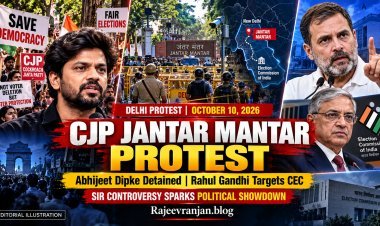
The Cockroach Janta Party (CJP) has also been associated with protests concerning electoral transparency and the election chief.
However, the reported plans for a political rally should not be confused with a formal parliamentary removal proceeding.
A public demonstration may generate political pressure, but it does not independently initiate constitutional removal.
For that process to begin, MPs must submit a valid notice satisfying the applicable requirements.
The Speaker or Rajya Sabha Chairman must then determine whether it can be admitted.
What Has the BJP Said About the Protests?
The BJP has rejected allegations that the electoral-roll revision controversy establishes deliberate manipulation.
Government and ruling-party representatives have criticised opposition protests, arguing that electoral institutions should not be undermined through unsubstantiated accusations.
Opposition leaders, meanwhile, maintain that questioning the Election Commission's decisions is a legitimate part of democratic accountability.
The dispute reflects differing views about how concerns regarding constitutional institutions should be addressed.
The government emphasises institutional stability and established procedures.
Opposition parties emphasise transparency, voting rights and the need to investigate alleged wrongdoing.
The legal process provides a framework for examining allegations without treating political claims as findings of guilt.
Om Birla Also Addresses Parliament Special Session Speculation
The Speaker's remarks came during a wider press interaction involving several parliamentary matters.
Birla was also asked about speculation concerning a special session of Parliament.
He explained that the decision to summon Parliament is governed by Article 85 of the Constitution.
The government plays the central role in advising the President on summoning Parliament.
Birla did not announce a special session.
His comments came ahead of the 12th BRICS Parliamentary Forum, scheduled to take place in New Delhi on October 26–27.
The forum will bring together parliamentary representatives from BRICS member and partner countries.
Discussions are expected to cover institutional resilience, innovation, technology, sustainable development and international cooperation.
Prime Minister Narendra Modi is scheduled to attend the event.
What Happens Next for Gyanesh Kumar?
The latest developments leave several questions unresolved.
Will opposition parties submit another notice?
Reports indicate that a fresh attempt is being considered, but the timing of any new submission remains uncertain.
Will the Speaker admit it?
Om Birla has said that any notice will be evaluated under parliamentary rules.
Admission is not automatic.
What happens to the pending Rajya Sabha notice?
The reported second attempt remains pending in the Upper House, and its status may influence subsequent political decisions.
Will SIR protests continue?
The opposition's November 1 rally could bring further attention to the electoral-roll controversy.
Will the Election Commission introduce additional corrective measures?
Further clarification of voter-list verification, exclusions, appeals and enrolment processes could become important in addressing public concerns.
Ultimately, any removal proceeding will depend on evidence and the constitutional process rather than political pressure alone.
A Test of Constitutional Accountability
Lok Sabha Speaker Om Birla's statement has clarified how Parliament would approach any fresh attempt to remove Chief Election Commissioner Gyanesh Kumar.
The Speaker has committed to following parliamentary rules and established constitutional procedures.
But he has not announced the admission of a fresh motion.
The distinction is essential.
Opposition parties have the right to raise concerns about the Election Commission and seek accountability through lawful channels.
At the same time, the Constitution provides significant protection to the Chief Election Commissioner to preserve the independence of the office.
The controversy surrounding SIR has intensified the political debate, but allegations must still be evaluated through the appropriate procedures.
The central issue now is whether the opposition can present evidence that satisfies the demanding constitutional standard for removal—not simply whether it can generate political support for the demand.