


Diwali 2026 Lakshmi Puja Shubh Muhurat: City-Wise Timings and How to Perform Lakshmi Puja at Home
Diwali 2026 falls on November 8. Check city-wise Lakshmi Puja Muhurat for Delhi, Mumbai, Patna and more, plus a simple guide to performing puja at home.
 Rajeev
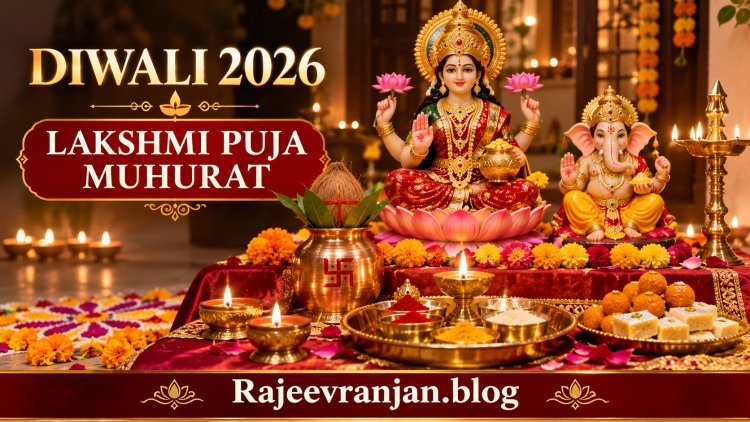

Diwali 2026 Lakshmi Puja Shubh Muhurat: City-Wise Timings and How to Perform Lakshmi Puja at Home
Diwali 2026 will be celebrated on Sunday, November 8. From Patna and Delhi to Mumbai, Kolkata and Bengaluru, here is a practical guide to the auspicious Lakshmi Puja timings, essential rituals and preparations for Deepawali.
As millions of Indian households prepare to illuminate their homes with diyas, decorate their entrances with rangoli and gather for evening prayers, one important question is on everyone's mind: What is the most auspicious time to perform Lakshmi Puja on Diwali 2026?
The answer depends partly on where you live.
Although Diwali is celebrated across India, the recommended evening Lakshmi Puja muhurat differs between cities because sunset and astrological calculations vary by location.
According to Drik Panchang, Diwali Lakshmi Puja will take place on Sunday, November 8, 2026. The recommended worship period in New Delhi is 5:54 PM to 7:50 PM, while in Patna, Bihar, it is 5:28 PM to 7:25 PM.
These timings are calculated according to the traditional Hindu Panchang, particularly the overlap of Pradosh Kaal and Vrishabha Lagna.
But observing Diwali is about more than watching the clock. For many families, Lakshmi Puja is a moment to express gratitude, renew their hopes and welcome the coming year with faith and optimism.
Here is everything you need to know about Diwali 2026, including city-wise timings and a simple way to perform Lakshmi Puja at home.
When Is Diwali in 2026? Date and Amavasya Tithi
Diwali date: Sunday, November 8, 2026
Amavasya Tithi begins: November 8, 2026, at 11:27 AM
Amavasya Tithi ends: November 9, 2026, at 12:31 PM
These Amavasya timings follow the calculations published by Drik Panchang for New Delhi.
Diwali, also known as Deepavali or Deepawali, is traditionally associated with Kartik Amavasya, the new-moon day of the Hindu lunar calendar.
The festival carries several religious and cultural meanings.
In the Ramayana tradition, it is associated with the return of Lord Rama to Ayodhya after his exile and victory over Ravana.
For many Hindu households, the evening is dedicated to Goddess Lakshmi, revered as the goddess of wealth, prosperity and well-being.
Lord Ganesha, associated with wisdom and the removal of obstacles, is also worshipped alongside Goddess Lakshmi.
These traditions reflect a central theme of Diwali: the symbolic victory of light over darkness, knowledge over ignorance and hope over despair.
Diwali 2026 Lakshmi Puja Muhurat: City-Wise Auspicious Timings
The following table lists the recommended evening Lakshmi Puja timings for major Indian cities on November 8, 2026.
Lakshmi Puja Muhurat 2026 — City-Wise List
| City | Lakshmi Puja Shubh Muhurat |
|---|---|
| New Delhi | 5:54 PM – 7:50 PM |
| Mumbai | 6:27 PM – 8:27 PM |
| Patna | 5:28 PM – 7:25 PM |
| Kolkata | 5:20 PM – 7:18 PM |
| Bengaluru | 6:17 PM – 8:20 PM |
| Chennai | 6:07 PM – 8:09 PM |
| Hyderabad | 6:07 PM – 8:08 PM |
| Ahmedabad | 6:22 PM – 8:20 PM |
| Pune | 6:24 PM – 8:24 PM |
| Jaipur | 6:03 PM – 7:59 PM |
| Chandigarh | 5:52 PM – 7:46 PM |
| Gurugram | 5:55 PM – 7:51 PM |
| Noida | 5:54 PM – 7:49 PM |
Source: Drik Panchang's November 8, 2026, Lakshmi Puja calculations for Patna and other cities.
All timings are in Indian Standard Time (IST). Minor differences may appear between Panchang publications because of calculation methods and rounding.
Families should follow the Panchang appropriate to their location and established religious tradition.
Diwali 2026 Lakshmi Puja Muhurat in Patna, Bihar
For families celebrating Diwali in Bihar's capital, the recommended Lakshmi Puja period is:
Date: Sunday, November 8, 2026
Lakshmi Puja Muhurat: 5:28 PM to 7:25 PM
Pradosh Kaal: 5:04 PM to 7:40 PM
Vrishabha Kaal: 5:28 PM to 7:25 PM
These are location-specific timings published by Drik Panchang for Patna.
Residents of other Bihar cities, including Gaya, Muzaffarpur, Bhagalpur and Darbhanga, should check their respective local Panchang rather than automatically using Patna's timings.
Even cities within the same state can have slightly different recommended worship periods.
Why Does the Lakshmi Puja Muhurat Change From City to City?
A common misconception is that one auspicious time applies everywhere in India.
In reality, traditional Panchang calculations consider local astronomical conditions.
Two concepts are especially important for Diwali Lakshmi Puja.
What Is Pradosh Kaal?
Pradosh Kaal refers to the period around and after sunset that holds particular religious significance in several Hindu worship traditions.
For Diwali, evening worship during Pradosh Kaal is widely recommended.
Because the sun sets at different times in Kolkata, Patna, Delhi and Mumbai, the corresponding Pradosh periods also differ.
What Is Vrishabha Lagna?
Vrishabha Lagna, or Taurus ascendant, is classified as a Sthir Lagna, meaning a fixed ascendant in traditional Hindu astrology.
Many Panchang traditions recommend performing Lakshmi Puja when Vrishabha Lagna overlaps with Pradosh Kaal.
Drik Panchang specifically recommends this overlap for ordinary household Lakshmi Puja rather than relying solely on general Choghadiya timings.
This explains why the recommended worship window is not identical across Indian cities.
Deepawali Par Lakshmi Puja Kaise Karein? A Simple Step-by-Step Guide
For families performing Lakshmi Puja at home, elaborate arrangements are not always necessary.
A clean worship space, appropriate offerings and observance of family customs can form the foundation of the ceremony.
The following is a simplified household approach. More elaborate traditions, including Shodashopachara Puja, involve additional ritual steps.
Step 1: Clean and Prepare the Puja Area
Begin by cleaning the home, particularly the place where the puja will take place.
Many families decorate their entrances with flowers, rangoli and illuminated diyas.
Choose a clean, peaceful location for the worship arrangements.
A small wooden platform or raised surface can serve as the puja altar.
Cover it with a clean red or yellow cloth, according to family custom.
Step 2: Arrange the Lakshmi-Ganesha Idols
Place images or idols of Goddess Lakshmi and Lord Ganesha on the prepared platform.
Some families also include Goddess Saraswati, Lord Kubera or their household deities.
Arrange the idols respectfully and keep sufficient space for the diya, flowers and offerings.
Step 3: Prepare the Puja Samagri
Commonly used Lakshmi Puja materials include:
-
Images or idols of Goddess Lakshmi and Lord Ganesha
-
A clean red or yellow cloth
-
Flowers and garlands
-
Kumkum, roli and turmeric
-
Akshat, or unbroken rice
-
A diya with ghee or oil
-
Incense
-
A kalash with clean water
-
Coconut and mango leaves, where customary
-
Fruits, sweets and other prasad
-
Panchamrit, if used in the family tradition
-
Aarti thali and bell
The exact requirements differ between communities.
There is no need to purchase expensive decorative items simply to make the ceremony appear elaborate.
Step 4: Begin With Ganesh Puja
At the selected muhurat, sit comfortably before the altar.
Light the diya safely and begin with prayers to Lord Ganesha.
Many families offer flowers, akshat and sweets while seeking blessings for wisdom and the removal of obstacles.
A commonly recited mantra is:
ॐ गं गणपतये नमः।
Om Gam Ganapataye Namah.
The mantra is an invocation to Lord Ganesha.
Step 5: Worship Goddess Lakshmi
After Ganesh Puja, offer flowers and other customary offerings to Goddess Lakshmi.
Devotees may meditate upon the goddess and pray for the well-being of their families.
One traditional Lakshmi mantra cited by Drik Panchang is:
ॐ ह्रीं श्रीं लक्ष्म्यै नमः।
Om Hrim Shrim Lakshmyai Namah.
It is a devotional salutation to Goddess Lakshmi.
Families familiar with formal rituals may continue with the established Shodashopachara procedure, while others may follow their simpler household custom.
Step 6: Offer Prasad and Perform Aarti
Offer the prepared fruits and sweets.
Complete the worship with Lakshmi Aarti and prayers.
Many households sing the traditional Om Jai Lakshmi Mata aarti.
Family members may then receive prasad and exchange Diwali greetings.
Step 7: Light Diyas and Share the Celebration
After the main puja, many families illuminate their homes with diyas.
Place lamps in safe locations away from curtains, dry decorations and children's reach.
The evening can continue with a shared meal, visiting relatives or distributing sweets among neighbours.
The traditional puja sequence is not identical in every region. Families should respect their customary practices or seek guidance from a trusted priest when undertaking a detailed ritual for the first time.
What Should You Do Before the Lakshmi Puja Muhurat Begins?
The easiest way to avoid last-minute confusion is to complete most arrangements before the recommended worship period begins.
Clean the puja area, arrange the idols, prepare prasad and assemble the required materials in advance.
If you are celebrating in Patna, for example, the recommended period begins at 5:28 PM. Completing preparations before that time allows the family to begin worship calmly.
The same principle applies to households in Delhi, Mumbai and other cities.
Keep the ceremony manageable for elderly relatives and younger children.
Anyone observing a traditional fast should consider their individual health needs. Fasting is not a requirement that should override medical advice.
Common Lakshmi Puja Mistakes Families Can Avoid
Preparing for Diwali often involves balancing shopping, cooking, cleaning and family responsibilities.
Three practical issues deserve particular attention.
Using the wrong city's muhurat: A widely shared festival graphic may display timings calculated for Delhi even when the reader lives in Bihar or Maharashtra.
Starting preparations at the beginning of the muhurat: If the altar is not ready, families may spend much of their intended worship period searching for materials.
Treating expensive purchases as a religious necessity: Traditional worship centres on devotion and customary offerings, not the financial value of decorations or gifts.
It is also worth remembering that puja procedures vary by region, family and religious tradition. A different customary sequence should not automatically be treated as incorrect.
How to Make Diwali 2026 More Meaningful for Your Family
The festival offers opportunities for celebration that extend beyond the main prayer ceremony.
For a family with young children, making a simple rangoli together can become a way to introduce the meaning of Diwali.
Those celebrating away from home can arrange a modest puja space, connect with relatives through a video call and prepare a favourite traditional sweet.
People who enjoy quieter celebrations may prefer devotional music, a homemade dinner and a few carefully placed diyas.
Families interested in traditional festivities might organize a shared Lakshmi Aarti followed by storytelling about the Ramayana or local Diwali customs.
Others may choose to donate food, support local artisans or share sweets with neighbours.
These personal choices can make the celebration more memorable without adding unnecessary financial pressure.
Diwali Traditions Across India: One Festival, Many Expressions
Although Lakshmi Puja is central to Diwali celebrations in many northern and western Indian communities, the festival is observed differently across India.
In Gujarat, Diwali is associated with business traditions, including Chopda Pujan, during which account books are ceremonially worshipped.
In West Bengal, Kali Puja is a significant observance associated with the Diwali period.
In several southern Indian traditions, Deepavali celebrations prominently feature Naraka Chaturdashi and an early-morning ritual bath.
These differences illustrate the cultural diversity of Indian festivals.
There is no single household celebration style that represents every community.
A Diwali Celebration Rooted in Faith, Gratitude and Togetherness
Diwali 2026 falls on Sunday, November 8, with the evening Lakshmi Puja muhurat beginning at different times across Indian cities.
For devotees following the Pradosh Kaal and Vrishabha Lagna tradition, consulting a city-specific Panchang is the most useful starting point.
Once the timing is known, the rest of the celebration can remain beautifully simple.
A carefully prepared altar, a few lamps, sincere prayers and the presence of loved ones can create a deeply meaningful occasion.
Beyond the lights and decorations, Deepawali remains an opportunity to welcome hope, express gratitude and strengthen the relationships that make a house feel like home.
Rajeevranjan.blog wishes readers a peaceful, joyful and prosperous Diwali 2026.