


Trump Signals Possible Iran Peace Deal After US Midterm Defeat, but Major Obstacles Remain
Trump signals openness to an Iran peace deal after the 2026 US midterms. Qatar-led talks continue as nuclear demands and the Hormuz crisis threaten progress.
 Rajeev

Trump Signals Possible Iran Peace Deal After US Midterm Defeat, but Major Obstacles Remain
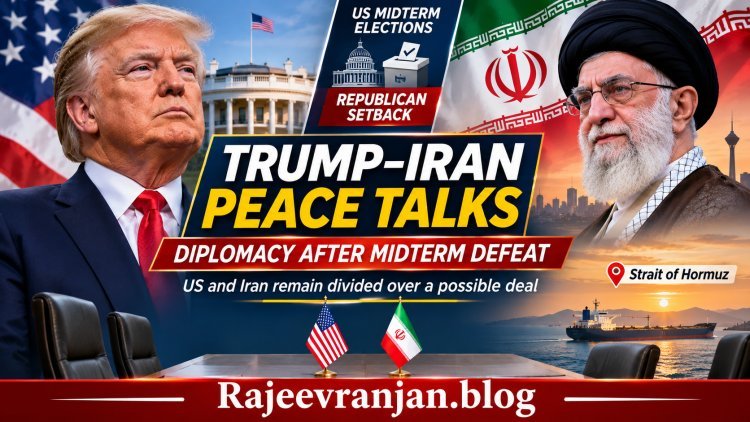
President Donald Trump has suggested that further US military strikes against Iran may not be necessary if diplomatic negotiations produce a strong agreement. The comments come after a damaging Republican defeat in the US midterm elections, but deep disagreements over sanctions, nuclear restrictions and the Strait of Hormuz continue to threaten peace efforts.
WASHINGTON | November 9, 2026
The political consequences of America's war with Iran are becoming increasingly difficult for President Donald Trump to ignore.
Less than a week after Republicans suffered major losses in the November 3 midterm elections, Trump has indicated that he is unlikely to authorize additional military strikes against Iran if negotiations move towards an acceptable settlement.
Speaking to CNN in a telephone interview on Sunday, November 8, the US president suggested that military action would probably be unnecessary if Tehran agreed to sufficiently strong terms.
Yet Washington's diplomatic position remains complicated.
Secretary of State Marco Rubio has warned that negotiations have produced limited progress, while Iranian officials continue to demand sanctions relief, access to frozen assets and other concessions before accepting a broader agreement.
Qatar, which has played a central role in mediating between Washington and Tehran, is continuing efforts to narrow those differences.
Trump is scheduled to meet Qatari Prime Minister Sheikh Mohammed bin Abdulrahman Al-Thani at the White House on Monday, November 9, in another potentially significant moment for the negotiations.
The meeting comes against a dangerous backdrop: maritime incidents around the Strait of Hormuz, continued American restrictions on Iran and a regional conflict that has disrupted energy supplies and international shipping.
The central question is no longer simply whether Trump is willing to negotiate. It is whether Washington and Tehran can reach an agreement before renewed military escalation undermines the diplomatic process.
What Did Trump Say About New Military Strikes Against Iran?
Trump's latest comments suggest that diplomacy remains an option, despite his repeated warnings that the United States could resume major military operations.
On November 8, the president told CNN that the likelihood of new attacks depended on Iran's willingness to accept a strong agreement.
His remarks indicated that further strikes were highly unlikely to be necessary if negotiations succeeded.
However, Trump did not rule out military action entirely.
He also warned that the United States had identified potential Iranian infrastructure targets, including bridges, that could be attacked if hostilities intensified.
This combination of diplomatic openness and military threats reflects Washington's broader negotiating approach.
The administration is attempting to maintain pressure on Tehran while keeping open the possibility of a settlement.
But a willingness to negotiate should not be mistaken for evidence that an agreement is close.
Rubio said on Sunday that he did not expect an imminent diplomatic breakthrough and described some Iranian demands as unrealistic.
The differences between Trump's optimistic signals and Rubio's caution illustrate the uncertainty surrounding the talks.
How the US Midterm Elections Changed the Political Situation
The November 3 midterm elections delivered a substantial political setback to Trump's Republican Party.
Democrats won control of both the House of Representatives and the Senate, according to the Associated Press.
The results reflected voter dissatisfaction with several issues, including the cost of living, government accountability and the war with Iran.
The conflict had become an increasingly difficult political issue for Republicans during the campaign.
The war's economic effects, particularly pressure on energy markets, added to concerns among voters already facing high living costs.
Following the election, Trump acknowledged that the Iran war had contributed to Republican losses.
Vice President JD Vance went further, directly attributing the defeat to the conflict.
Trump subsequently expressed disagreement with the strength of Vance's assessment.
These differences indicate that the administration is facing internal debate over how closely the election result should influence its Iran strategy.
For Trump, the political problem is considerable.
His party's defeat means he must now confront a Congress in which Democrats control both chambers, creating greater potential for investigations, scrutiny of military decisions and opposition to his domestic legislative agenda.
Nevertheless, the election results do not automatically force the president to end military operations or accept Iran's demands.
Foreign-policy decisions remain subject to a complex division of authority between the presidency and Congress.
The midterm outcome therefore increases political pressure for a diplomatic solution without guaranteeing that one will be reached.
Why Are the United States and Iran Still at War?
The current conflict began on February 28, 2026, when the United States and Israel launched military strikes against Iran.
Tehran responded with attacks on Israel and targets in Gulf countries hosting American military facilities.
The fighting subsequently affected a wider region, including maritime routes essential to international energy trade.
One of the most significant consequences has been disruption around the Strait of Hormuz, the narrow waterway connecting the Persian Gulf with the Gulf of Oman.
Iran has sought to exert pressure through attacks and restrictions affecting maritime traffic.
The United States began enforcing a blockade on movements to and from Iranian ports in April.
The conflict has also intensified tensions involving Iran-aligned groups elsewhere in the Middle East.
These developments have complicated diplomacy because the dispute now extends beyond Iran's nuclear programme.
Any durable settlement would need to address the immediate military confrontation, maritime access, economic restrictions and wider regional security concerns.
The United States and Iran disagree not only over the terms of a possible agreement but also over the sequence in which concessions should occur.
Iran's Seven Demands: What Is Blocking a Peace Agreement?
One of the largest obstacles concerns Tehran's conditions for negotiations.
On November 5, Reuters reported that Iran had submitted a nuclear proposal to Washington through Qatar.
A senior Iranian official said the proposal could be discussed after the United States satisfied seven Iranian demands.
Those demands include lifting sanctions, releasing frozen Iranian assets and addressing reparations related to the war.
Iranian officials have also linked progress to the American blockade and restrictions affecting the Strait of Hormuz.
Washington, however, insists that Iran's nuclear programme must be part of the initial negotiating framework.
The disagreement is fundamental.
Iran wants significant relief from economic and military pressure before committing to broader negotiations.
The United States wants assurances addressing nuclear and security concerns before making concessions that Tehran considers essential.
This creates a diplomatic sequencing problem.
Both sides are seeking guarantees from the other before taking politically sensitive steps.
Iranian security official Mohsen Rezaei has publicly emphasized Tehran's demands, while American officials have described aspects of the Iranian position as unacceptable.
Until negotiators resolve those differences, even a limited agreement will remain difficult.
Qatar's Role: Can Mediation Prevent Another Escalation?
Qatar has emerged as an important intermediary in the negotiations.
The Gulf country maintains diplomatic channels that allow it to communicate with both Washington and Tehran.
Qatari mediators have helped exchange proposals and explore possible arrangements to reduce tensions around the Strait of Hormuz.
The scheduled November 9 meeting between Trump and Qatar's prime minister is therefore significant.
Sheikh Mohammed bin Abdulrahman Al-Thani also serves as Qatar's foreign minister, placing him at the centre of the country's diplomatic efforts.
Vice President JD Vance is also expected to meet the Qatari leader.
The talks could provide an opportunity to clarify Washington's position and assess whether Iran's latest proposals offer a basis for further negotiations.
However, no agreement should be assumed merely because senior officials are meeting.
The reported White House meeting was scheduled at the time of writing. Its outcome had not yet been established.
Qatar has also indicated that efforts to reach an agreement are continuing despite reports suggesting negotiations had failed.
That provides evidence of an active diplomatic channel, not confirmation that the parties are close to settling their differences.
The Strait of Hormuz Remains a Major Obstacle
While diplomats discuss possible compromises, maritime tensions continue.
On November 8, Reuters reported competing accounts of incidents involving commercial vessels near the Strait of Hormuz and the Gulf of Oman.
Iranian authorities said two oil tankers had struck mines, while another vessel had caught fire.
The United States separately reported disabling a commercial vessel that it said was attempting to breach its blockade.
Reuters stated that it could not independently confirm the reported attacks.
The incidents demonstrate how quickly developments at sea could undermine diplomatic progress.
The Strait of Hormuz is crucial to global oil and liquefied natural gas transportation.
Disruption to shipping can increase transport costs, affect insurance arrangements and create uncertainty for energy importers.
Even when negotiations appear promising, maritime confrontations can influence financial markets because traders must assess the risk of further supply interruptions.
For both Washington and Tehran, control over access to the waterway remains a powerful bargaining issue.
It is also a major reason why the conflict has consequences extending far beyond the Middle East.
What Do Trump's Iran Talks Mean for India?
For India, the conflict matters primarily because of its implications for energy security, shipping and regional stability.
India depends heavily on imported crude oil, making it sensitive to sustained increases in international petroleum prices.
The Strait of Hormuz is an important passage for energy supplies originating in the Gulf.
Prolonged disruption could increase shipping and insurance costs, complicate procurement decisions and contribute to pressure on domestic fuel-related expenses.
A credible agreement reducing attacks on shipping and easing restrictions on energy movements could help improve market confidence.
However, negotiations alone do not guarantee lower oil prices.
Global energy prices also respond to production decisions, inventories, demand and expectations about future supply.
India also has important economic and diplomatic relationships with Gulf countries, the United States and Iran.
A wider regional escalation could affect trade routes and the security environment for Indian citizens living and working across the Gulf.
For New Delhi, a stable diplomatic settlement would therefore have implications beyond the immediate relationship between Washington and Tehran.
Could Trump's Midterm Defeat Accelerate Peace Talks?
The election results have changed the political environment, but their effect on diplomacy remains uncertain.
There are two competing possibilities.
The first is that Trump may see a negotiated settlement as a way to reduce economic pressure and respond to voters' concerns about the prolonged conflict.
A successful agreement could allow the administration to argue that its strategy produced security concessions without requiring further large-scale military operations.
The second possibility is that Washington may maintain or increase pressure in an attempt to extract stronger terms.
Trump has not abandoned the threat of renewed strikes, and his administration continues to apply economic and military restrictions.
Iran, meanwhile, may calculate that Republican electoral losses have weakened Trump's negotiating position.
Reuters reported in October that officials believed Tehran was prolonging difficult negotiations partly to influence the political environment surrounding the midterms.
That assessment was attributed to officials and should not be treated as independently established proof of Iranian intentions.
The danger is that both governments may overestimate their bargaining advantage.
If Washington believes Tehran is under unsustainable economic pressure, while Tehran believes Trump is politically weakened, neither side may be willing to make the concessions necessary for an agreement.
What Happens Next in the US-Iran Peace Process?
The immediate diplomatic focus is the scheduled White House meeting with Qatar's prime minister.
Beyond that meeting, several questions remain unresolved.
Washington and Tehran must determine whether their proposals offer a workable starting point for negotiations.
They also need to address the relationship between nuclear restrictions, sanctions relief and maritime access.
Any agreement concerning the Strait of Hormuz would require clear terms that both sides consider enforceable.
Further military incidents could complicate that process.
The position of regional governments will also matter because the conflict has affected shipping, energy infrastructure and security across the Gulf.
For now, the negotiations remain active but uncertain.
Trump's latest comments suggest that a diplomatic settlement is still possible.
Rubio's assessment, however, indicates that the administration does not regard a breakthrough as imminent.
A Diplomatic Opening, Not Yet a Peace Agreement
The November 2026 US midterm elections have added a new dimension to the conflict between Washington and Tehran.
Republican electoral losses have increased scrutiny of Trump's Iran strategy, while continued disruption around the Strait of Hormuz has reinforced the economic consequences of the war.
The president's latest comments indicate that he remains open to avoiding further strikes if negotiations produce acceptable terms.
Qatar's mediation provides an important channel for that possibility.
But the disagreements remain substantial.
Iran continues to demand sanctions relief and other concessions, while Washington insists that nuclear and security issues must be addressed.
As of November 9, 2026, no comprehensive US-Iran peace agreement has been confirmed.
The next phase will depend on whether diplomatic discussions can bridge the gap between the two governments before renewed military escalation makes an agreement even more difficult.