


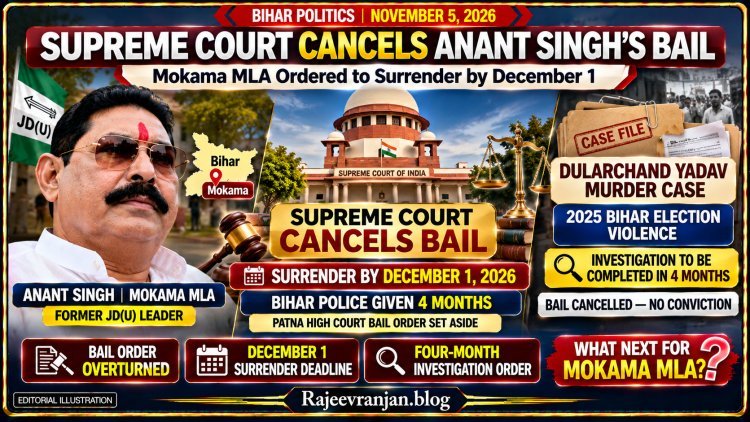
Supreme Court Cancels Anant Singh's Bail, Orders Surrender by December 1
Supreme Court cancels Mokama MLA Anant Singh's bail in the Dularchand Yadav murder case, orders surrender by December 1 and directs a four-month probe.
 Rajeev

From Mokama's Political Strongman to Supreme Court Surrender Order: Anant Singh Faces Fresh Legal Setback
The Supreme Court has ordered Bihar MLA Anant Singh to surrender by December 1 after cancelling his bail in a murder case linked to the 2025 Assembly election campaign. The decision raises important questions about political influence, the criminal justice system and the legal standards governing bail in serious offences.
NEW DELHI / PATNA | NOVEMBER 5, 2026
For years, Anant Kumar Singh has been one of the most recognisable—and controversial—figures in Bihar's political landscape.
Popularly known among supporters as Chhote Sarkar, the Mokama legislator has built a political career marked by repeated electoral victories, shifting party affiliations and longstanding legal controversies.
Now, his political position faces another test.
The Supreme Court of India has cancelled the bail granted to Singh in connection with the murder of Dularchand Yadav, who was killed during the 2025 Bihar Assembly election campaign.
In its October 30 order, a bench comprising Justices M. M. Sundresh and Prasanna B. Varale directed the MLA to surrender before the authorities on or before December 1, 2026.
The court also instructed Bihar Police to complete the investigation within four months.
The decision overturns the bail relief Singh had obtained from the Patna High Court in March.
For the legislator, the ruling creates an immediate legal obligation to return to custody.
For Bihar's political establishment, it arrives at a particularly sensitive moment—days after the JD(U) expelled Singh and his wife, former MLA Neelam Devi, from the party.
But the Supreme Court's decision should not be confused with a verdict on Singh's guilt.
The court has cancelled his bail. It has not convicted him of murder.
That distinction is central to understanding the case.
What Exactly Did the Supreme Court Order?
On October 30, the Supreme Court examined a petition challenging the Patna High Court's decision to release Anant Singh on bail.
The petition was filed by Neeraj Kumar, the grandson of Dularchand Yadav.
The petitioner argued that the High Court had not adequately considered the serious nature of the allegations and Singh's criminal antecedents.
After examining the submissions, the Supreme Court set aside the earlier bail order.
The bench directed Singh to surrender by December 1 and asked the investigating authorities to complete their work within four months.
The case was listed for further consideration after that period.
The court's intervention means that the earlier High Court order can no longer serve as the basis for Singh remaining free on bail in this case.
However, the eventual outcome of the criminal proceedings remains to be determined through the appropriate legal process.
Key Points of the Supreme Court Order
| Issue | Supreme Court's Direction |
|---|---|
| Bail granted by Patna High Court | Cancelled |
| Date of Supreme Court order | October 30, 2026 |
| Accused | Anant Kumar Singh |
| Criminal case | Dularchand Yadav murder |
| Surrender deadline | December 1, 2026 |
| Bihar Police investigation | Complete within four months |
| Next judicial review | After the investigation period |
| Finding of guilt | No conviction established |
The ruling represents a significant change in Singh's custody status, but it does not determine the final outcome of the murder trial.
Why Did the Court Cancel His Bail?
The Supreme Court's concerns centred on the seriousness of the alleged offence and the factors considered by the Patna High Court.
According to reporting on the proceedings, the bench concluded that the High Court had not given sufficient weight to the gravity of the allegations and Singh's criminal antecedents.
The court was also informed of concerns about the possible influence of the accused on the investigation and witnesses.
For courts considering bail in serious criminal cases, relevant factors can include the nature of the allegations, available evidence, criminal antecedents and the possibility of interference with the judicial process.
Bail decisions require balancing the liberty of an accused person against the legitimate needs of investigation and trial.
The Supreme Court found sufficient grounds to interfere with the High Court's earlier decision.
Importantly, a court's examination of criminal antecedents at the bail stage is not the same as determining guilt in the case being heard.
Past allegations, pending cases and convictions have different legal significance.
The eventual murder trial must assess the relevant evidence independently.
The Dularchand Yadav Murder Case: What Happened?
The case dates back to October 30, 2025, when Dularchand Yadav was killed in the Mokama area during the Bihar Assembly election campaign.
Yadav was a former Rashtriya Janata Dal leader who was supporting Jan Suraaj Party candidate Piyush Priyadarshi.
According to the police complaint, violence occurred following a confrontation involving rival political supporters.
The FIR alleged that Anant Singh and his associates were involved in an attack on Yadav.
The allegations included assault, a gunshot injury and Yadav being run over by a vehicle.
These are prosecution allegations, not judicially established findings.
Singh has denied involvement in the killing.
His defence has disputed the prosecution's version of events and alleged that the case was politically motivated.
The accused also contested the claim that Yadav was run over by Singh's vehicle.
The competing accounts remain matters for investigation and trial.
Why the Case Attracted National Attention
The killing occurred during a politically charged election campaign.
Mokama has a long history of intense political competition, and Singh has been an influential figure in the constituency for decades.
The alleged involvement of a sitting political leader transformed the investigation into a matter of wider public interest.
Questions about electoral violence, political influence and witness safety became central to the proceedings.
The Supreme Court's latest order has renewed attention to those concerns.
Timeline: From the 2025 Killing to the Supreme Court Order
| Date | Development |
|---|---|
| October 30, 2025 | Dularchand Yadav killed during the Bihar Assembly election campaign |
| November 1, 2025 | Bihar Police arrest Anant Singh |
| November 2025 | Singh wins the Mokama Assembly election while in custody |
| March 19, 2026 | Patna High Court grants bail to Singh |
| October 2026 | Dularchand Yadav's grandson challenges the bail order |
| October 24, 2026 | JD(U) expels Singh and Neelam Devi for six years |
| October 30, 2026 | Supreme Court cancels bail and orders surrender |
| December 1, 2026 | Deadline for Singh to surrender |
| Late February 2027 | Approximate four-month investigation period concludes, subject to court directions |
This timeline shows why the latest order has both legal and political significance.
The Supreme Court ruling comes almost exactly one year after the original killing.
The Petition That Changed Anant Singh's Legal Position
The challenge to Singh's bail was brought by Dularchand Yadav's grandson, Neeraj Kumar.
The petition questioned the legal basis on which the Patna High Court had granted relief.
The petitioner's lawyers argued that the court should have considered the seriousness of the allegations and the accused's background more carefully.
They also raised concerns about the possibility of witnesses being intimidated.
The Bihar government informed the Supreme Court about Singh's criminal history.
However, the defence disputed aspects of the information presented against him.
Senior advocate Siddharth Dave, representing Singh, challenged the prosecution's account and argued that the petition relied on inaccurate claims.
The Supreme Court ultimately found grounds to cancel bail.
The decision illustrates the ability of higher courts to review bail orders when questions arise about the application of legal principles.
It also demonstrates the importance of considering the rights of victims' families in criminal proceedings.
What Has Anant Singh Said About the Ruling?
Following the Supreme Court's decision, Singh indicated that he would comply with the surrender order.
He expressed confidence in the judiciary and said he would appear before the court within the deadline.
At the same time, the legislator continued to deny the allegations against him.
He also accused JD(U) MLC Neeraj Kumar of being involved in a political conspiracy against him.
That allegation is separate from the petition filed by Dularchand Yadav's grandson, who has the same name.
The two individuals should not be confused.
Singh's allegation of a political conspiracy has not been established by a court.
The legislator's response reflects the overlap between his legal difficulties and recent political disputes.
However, those political disagreements do not determine the criminal case.
The evidence and applicable law will determine its outcome.
Political Setback: JD(U) Expels Anant Singh and His Wife
The bail cancellation arrived shortly after another major development.
On October 24, the Janata Dal (United) expelled Anant Singh and his wife, former legislator Neelam Devi, for six years.
The party cited alleged anti-party activities.
The expulsion followed Singh's support for a candidate opposed to the JD(U)'s official nominee in the Patna Graduates' constituency Legislative Council election.
His public criticism of party leaders also contributed to growing tensions.
The decision placed him outside the party organisation despite his election to the Assembly on a JD(U) ticket.
The political consequences have extended to Neelam Devi.
Reports indicate that the Bihar government removed her from a state-level programme implementation position and withdrew certain official privileges.
These developments show how rapidly the political situation surrounding the family has changed.
But the party expulsion and the murder proceedings are distinct matters.
One concerns internal party discipline.
The other concerns allegations of a serious criminal offence.
They must be evaluated separately.
Can Anant Singh Continue as Mokama MLA?
This is one of the most important questions arising from the controversy.
Cancellation of bail does not automatically disqualify a sitting MLA.
A legislator may face arrest, custody or criminal proceedings without immediately losing membership of the Assembly.
Disqualification can arise under specific constitutional and statutory provisions.
For example, certain criminal convictions can trigger disqualification under the Representation of the People Act, 1951.
Other circumstances may involve the anti-defection provisions of the Tenth Schedule of the Constitution.
However, being accused of a crime is not the same as being convicted.
Similarly, expulsion from a political party does not automatically determine whether the person continues to hold a legislative seat.
Reports indicate that the JD(U) has approached Bihar Assembly Speaker Prem Kumar seeking Singh's disqualification on anti-defection grounds.
Any such matter requires consideration under the applicable constitutional procedure.
As of the reporting reviewed, no final decision on that petition has been established.
Therefore, it would be premature to report that Singh has already lost his Mokama Assembly seat.
Why the December 1 Deadline Matters
The Supreme Court has given Singh until December 1, 2026, to surrender.
That date is legally significant.
Once the deadline arrives, compliance with the court's direction becomes essential.
Reports indicate that Singh's legal team sought time because of an upcoming wedding in his family.
The court nevertheless specified the December 1 deadline.
Singh has publicly indicated that he intends to comply.
However, a stated intention to surrender is not the same as confirmation that surrender has taken place.
As of November 5, the deadline remains in the future.
Any subsequent custody developments should be reported only after confirmation from the appropriate authorities.
Why the Court Ordered a Four-Month Investigation
The Supreme Court also directed Bihar Police to complete the investigation within four months.
The direction is important because criminal proceedings involving politically influential individuals can attract concerns about delay, witness safety and public confidence.
A timely investigation can help establish the relevant facts and allow the case to proceed through the judicial system.
However, completing an investigation does not necessarily mean that a trial will immediately conclude.
The investigation and trial are separate stages.
Investigators may collect evidence, examine witnesses and submit their findings through the prescribed legal process.
The court will then consider the subsequent proceedings.
A fair process must protect the rights of the accused while ensuring that relevant evidence is properly examined.
The Larger Question: Political Influence and Criminal Justice
The Anant Singh case has implications extending beyond one constituency.
It raises questions about the relationship between political influence and the criminal justice system.
India's courts regularly consider bail applications involving people from many backgrounds, including elected representatives.
The legal standards are intended to apply irrespective of political position.
Yet cases involving influential figures often receive heightened public attention.
Concerns may arise about witness protection, investigative independence and the ability of victims' families to obtain justice.
The Supreme Court's latest decision places renewed emphasis on the seriousness of the allegations and the need for a proper investigation.
At the same time, the accused retains the presumption of innocence unless guilt is established through due process.
That principle remains fundamental to the justice system.
What Happens Next?
Several developments will determine the next stage of the case.
Anant Singh's Surrender
The most immediate event is the December 1 deadline.
Authorities will need to confirm whether Singh complies with the Supreme Court's direction.
Bihar Police Investigation
Investigators must work towards completing the inquiry within the four-month period ordered by the court.
Further Supreme Court Hearing
The matter is expected to return before the Supreme Court after the investigation period.
Criminal Proceedings
The allegations will need to be examined under the applicable criminal procedure.
Political Developments
Any decision concerning Singh's legislative membership or the JD(U)'s disqualification petition will be a separate constitutional matter.
These developments could influence his political future, but their outcomes cannot yet be predicted.
Conclusion: Anant Singh Faces a Critical Legal and Political Test
The Supreme Court's cancellation of Anant Singh's bail represents a significant setback for the Mokama MLA.
The decision reverses the relief granted by the Patna High Court and requires him to surrender by December 1.
It also places renewed attention on the investigation into Dularchand Yadav's killing during the 2025 Bihar Assembly election campaign.
The ruling arrives amid political turmoil following Singh's expulsion from the JD(U).
But the most important questions remain before the criminal justice system.
What does the evidence establish?
Can investigators complete their work within the court's deadline?
And how will the legal proceedings affect Singh's future as a legislator?
The Supreme Court has decided that Anant Singh should not continue on the earlier bail. Whether he is criminally responsible for Dularchand Yadav's death remains a question for the courts to determine through trial.