


India–New Zealand FTA 2026: Piyush Goyal Highlights $20 Billion Investment, Zero Tariffs
India–New Zealand FTA takes effect October 20, 2026, offering zero tariffs on Indian exports and a $20 billion investment commitment. Key benefits explained.
 Rajeev

A New Trade Door Opens: India–New Zealand FTA Begins With Zero Tariffs and $20 Billion Investment Ambition
Beyond cheaper trade, the agreement could reshape opportunities for Indian manufacturers, small businesses, farmers and skilled professionals. But converting diplomatic commitments into actual investment and export growth will be the real test.
NEW DELHI | OCTOBER 20, 2026
A leather manufacturer in Agra looking for overseas buyers. A textile exporter in Tiruppur competing with international suppliers. A technology professional considering opportunities in New Zealand.
Until now, these individuals and businesses operated within a trade relationship constrained by tariffs, regulatory requirements and limited commercial connections.
That relationship enters a new phase today.
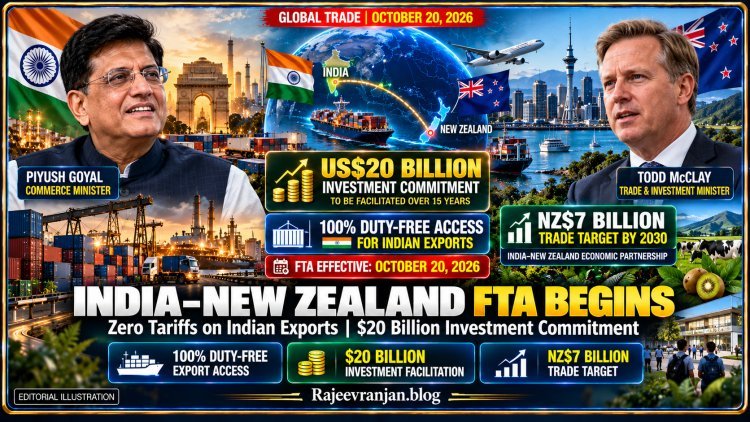
The India–New Zealand Free Trade Agreement officially comes into force on October 20, 2026, removing customs duties on qualifying Indian exports entering New Zealand and establishing a broader framework for investment, services, agriculture and professional mobility.
The agreement was signed on April 27, 2026, by Union Commerce and Industry Minister Piyush Goyal and New Zealand's Minister for Trade and Investment Todd McClay.
On October 19, the two ministers jointly marked the upcoming implementation through a virtual conference.
Speaking about the agreement, Goyal highlighted the opportunity to strengthen manufacturing, infrastructure, services and innovation through a commitment by New Zealand to facilitate US$20 billion in investment into India.
The amount is intended to be mobilised over 15 years.
The two governments are also working towards an ambitious target of increasing bilateral trade in goods and services to NZ$7 billion, approximately ₹35,000 crore, by 2030.
For India, the agreement represents more than another trade arrangement.
It offers an opportunity to expand into a developed market, strengthen investment relationships and create additional international opportunities for smaller businesses.
The Significance of October 20
The timing carries both economic and symbolic importance.
The agreement takes effect on Vijayadashami, a festival associated with new beginnings.
But the commercial significance is more immediate.
From the first day of implementation, New Zealand eliminates customs duties on all tariff lines covering Indian exports.
For Indian businesses, this removes tariff barriers that previously reached as high as 10% on certain goods.
The immediate beneficiaries are expected to include textiles, garments, leather products, footwear, engineering goods, jewellery, chemicals, pharmaceuticals and processed foods.
However, duty-free access does not mean exporters can ship any product without documentation or compliance requirements.
Businesses must still satisfy applicable rules of origin, product standards, customs procedures and other regulatory conditions.
Zero tariffs improve market access, but they do not automatically guarantee higher export sales.
That distinction is especially important for smaller companies entering the New Zealand market for the first time.
India–New Zealand FTA 2026: Key Facts
| Major Provision | Agreement Details |
|---|---|
| Effective Date | October 20, 2026 |
| Signing Date | April 27, 2026 |
| Indian Exports to New Zealand | 100% of tariff lines become duty-free |
| New Zealand Investment Commitment | Facilitation of US$20 billion over 15 years |
| Bilateral Trade Target | NZ$7 billion by 2030 |
| Indian Sectors Expected to Benefit | Textiles, leather, engineering, pharmaceuticals, jewellery and processed foods |
| Services Market Access | Approximately 118 sectors |
| Temporary Employment Entry Visas | 5,000 places |
| Working Holiday Visas | 1,000 places annually |
| Agricultural Cooperation | Apples, kiwifruit, honey and productivity initiatives |
| Sensitive Indian Sectors | Dairy, sugar, edible oils and certain agricultural products protected |
| Main Objective | Expand trade, investment, employment and economic cooperation |
Source: Ministry of Commerce and Industry, Government of India, October 19, 2026.
The $20 Billion Investment Commitment: What Does It Actually Mean?
One of the most significant provisions of the agreement concerns investment.
New Zealand has committed to facilitating approximately US$20 billion in investment into India over 15 years.
Piyush Goyal has identified manufacturing, infrastructure, agriculture, services and innovation as potential beneficiaries.
The commitment could support new industrial projects, business partnerships, technology development and employment.
But there is an important financial distinction.
A Commitment to Facilitate Investment Is Not the Same as Money Already Invested
The $20 billion figure should not be interpreted as an immediate transfer of funds to India.
It represents a long-term commitment to facilitate investment.
Actual investments will depend on individual companies, commercial decisions, regulatory approvals, financing arrangements and the availability of suitable projects.
For example, a New Zealand company may decide to establish a manufacturing partnership in India.
Another business might invest in agricultural technology, logistics or renewable-energy-related infrastructure.
Such transactions would contribute towards the broader investment objective only when they materialise.
There is no basis to claim that the entire $20 billion has already been received by India.
That distinction will be central to evaluating the agreement's eventual success.
Why India Wants More New Zealand Investment
India has been seeking to strengthen its position as a global manufacturing and services destination.
Foreign investment can support that objective by providing capital, technology and access to international supply networks.
New Zealand has experience in agricultural technology, food processing, logistics, education and several specialised service industries.
Closer cooperation could create opportunities for Indian businesses to acquire technical knowledge and establish international partnerships.
For Indian start-ups, the agreement may also support connections with investors and companies operating in the Asia-Pacific region.
However, the number of jobs ultimately created will depend on the projects undertaken.
The investment commitment should therefore be viewed as an economic opportunity rather than a guaranteed employment outcome.
Indian Exporters Get a Major Opportunity
For India's export-oriented businesses, tariff elimination is one of the most practical provisions.
Imagine an Indian footwear manufacturer selling products to a New Zealand retailer.
If those goods previously attracted an import tariff, the additional cost could make the product less competitive.
Removing that tariff reduces the landed cost of qualifying imports.
The manufacturer may then be able to offer more competitive pricing, improve margins or negotiate larger orders.
The agreement could create similar opportunities for several labour-intensive Indian industries.
Textiles and Apparel
India's garment and textile manufacturers compete internationally on cost, quality, design and delivery schedules.
Duty-free access may help exporters compete more effectively with suppliers from countries that already have preferential trade arrangements with New Zealand.
Leather and Footwear
Leather-product manufacturers and footwear exporters could benefit from reduced trade costs.
The opportunity is particularly relevant for manufacturing clusters where small and medium-sized enterprises depend on international orders.
Engineering Goods
New Zealand imports machinery, equipment and industrial components.
Indian engineering manufacturers may benefit from improved market access and stronger business relationships.
Pharmaceuticals and Medical Devices
The agreement includes provisions intended to streamline regulatory processes.
These could help eligible Indian pharmaceutical and medical-device companies navigate market-entry requirements more efficiently.
However, tariff elimination does not remove the need to meet New Zealand's medical and product-safety regulations.
Why Piyush Goyal Is Focusing on MSMEs
India's large corporations already have established international distribution networks.
Smaller businesses often face greater difficulties.
These include limited knowledge of foreign regulations, compliance costs, shipping arrangements and difficulty identifying reliable overseas buyers.
The India–New Zealand FTA aims to reduce some of these barriers.
The agreement emphasises cooperation involving micro, small and medium enterprises, women-led businesses, artisans and young entrepreneurs.
It also provides for improved access to trade-related information and connections between businesses in the two countries.
This could be particularly useful for Indian companies seeking to begin exporting rather than simply expanding existing operations.
Yet market access is only the first step.
A small exporter must still meet quality standards, maintain reliable delivery schedules and secure customers.
The agreement creates a more favourable environment, but businesses will need to use that opportunity effectively.
What About Indian Farmers and Dairy Producers?
Trade agreements often generate concerns among farmers because increased imports can create additional competition.
India has therefore preserved protection for several sensitive agricultural sectors.
The government has confirmed that dairy products, sugar, edible oils and certain other agricultural commodities remain excluded from tariff concessions.
This is particularly important for India's dairy industry.
New Zealand is an internationally competitive dairy exporter, while India's dairy economy supports millions of small producers.
The agreement does not provide unrestricted duty-free entry for New Zealand dairy products into India.
Special Arrangements for Apples, Kiwifruit and Honey
India has agreed to calibrated market access for selected New Zealand agricultural products.
These arrangements include tariff-rate quotas, minimum import prices and seasonal import conditions.
The agreement also establishes an Agricultural Productivity Partnership.
Under this framework, the two countries will cooperate on orchard management, agricultural technology, productivity and post-harvest practices.
Planned initiatives include Centres of Excellence connected with apples, kiwifruit and honey.
The Indian government says these arrangements are designed to combine trade opportunities with safeguards for domestic producers.
New Opportunities for Indian Students and Skilled Professionals
The agreement is not limited to goods and investment.
It also contains provisions relating to professional mobility and education.
According to the Indian government, New Zealand has offered market access covering approximately 118 services sectors.
The arrangement also includes dedicated opportunities for skilled Indian professionals.
A provision for 5,000 Temporary Employment Entry visa places is intended to support eligible workers.
An additional 1,000 Working Holiday visa places will be available annually.
For students, the agreement provides for post-study work opportunities of up to three years for eligible STEM bachelor's and master's graduates and up to four years for doctoral graduates.
These provisions could make New Zealand more attractive to Indian students and professionals.
However, visa provisions do not mean automatic entry, guaranteed employment or unrestricted work rights.
Applicants must still satisfy eligibility criteria, immigration requirements and applicable visa conditions.
Can India and New Zealand Reach NZ$7 Billion in Trade by 2030?
The two governments have established an aspirational goal of doubling bilateral trade in goods and services to NZ$7 billion by 2030.
The target is significant because existing trade remains relatively modest compared with India's relationships with several other major economies.
According to India's Commerce Ministry, bilateral merchandise trade was approximately US$1.1 billion during FY2025–26.
That figure covers goods and should not be confused with the broader target, which includes both goods and services.
Expanding trade will require Indian companies to increase exports while New Zealand businesses develop stronger commercial relationships with India.
The agreement may help by reducing tariffs, improving regulatory cooperation and encouraging investment.
However, reaching the target will also depend on global economic conditions, exchange rates, logistics costs and demand.
The trade goal should therefore be understood as an ambition, not a confirmed future outcome.
A Larger Strategic Partnership Beyond Trade
The free trade agreement also carries diplomatic significance.
India has been pursuing stronger economic partnerships with developed markets while seeking to diversify its international trade relationships.
New Zealand similarly wants to expand its trade connections and reduce excessive dependence on a limited number of export destinations.
The agreement supports the India–New Zealand Strategic Partnership: Roadmap to 2030.
It follows renewed political engagement between the two countries, including Prime Minister Narendra Modi's visit to New Zealand in July 2026.
The relationship now extends beyond conventional merchandise trade.
Education, technology, agricultural research, tourism, professional services and investment are becoming important areas of cooperation.
New Zealand's Trade and Investment Minister Todd McClay has described the agreement as an important opportunity to strengthen bilateral commercial relationships.
Both governments are emphasising that success will depend on businesses taking advantage of the new framework rather than simply celebrating its implementation.
What Happens Next?
With the agreement entering into force, attention now shifts from diplomatic negotiations to commercial implementation.
Indian exporters will need to understand the tariff preferences and documentation requirements available under the deal.
Businesses interested in supplying the New Zealand market must ensure that their products meet applicable origin and regulatory standards.
Government agencies will also need to promote awareness among exporters, especially smaller enterprises.
Meanwhile, both countries will work on investment promotion, agricultural cooperation and professional-mobility arrangements.
The longer-term outcome will be measured through export growth, investment flows, business partnerships and employment opportunities.
It will take time to determine how much additional trade the agreement actually generates.
Conclusion: A Trade Agreement With Ambition — and a Test of Execution
The India–New Zealand Free Trade Agreement marks an important development in India's international economic relationships.
Its immediate significance lies in duty-free access for qualifying Indian exports entering New Zealand.
The broader agreement also creates opportunities involving services, investment, agriculture and professional mobility.
Piyush Goyal has highlighted New Zealand's commitment to facilitate US$20 billion in investment over 15 years as a major opportunity for Indian businesses.
At the same time, safeguards covering sensitive agricultural sectors aim to protect domestic producers.
But the agreement's real impact will not be determined by tariff announcements alone.
It will depend on whether Indian exporters win new customers, whether companies establish productive investment partnerships and whether smaller businesses can benefit from the expanded market access.
India and New Zealand have opened a new economic corridor. The next challenge is turning that opportunity into measurable trade, investment and jobs.