


War Is "Ecocide": Iranian President Pezeshkian Warns of Devastating Environmental Toll of Middle East Conflicts
Iranian President Masoud Pezeshkian warns at a UN nature summit that military conflicts cause irreparable 'ecocide', destroying ecosystems, water resources, and fertile land across borders.
 Rajeev

Beyond the Battlefield: Iranian President Pezeshkian Warns War-Driven "Ecocide" Threatens Global Future
International Desk: Armed conflicts are universally measured by human casualties, displaced populations, and shattered infrastructure. However, speaking at an international nature summit in Armenia alongside United Nations Secretary-General António Guterres, Iranian President Masoud Pezeshkian called attention to a silent victim of modern warfare: the global environment.
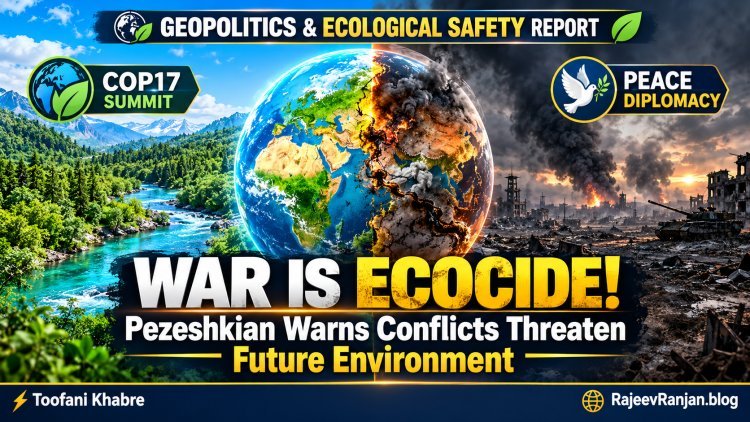
Pezeshkian characterized the destruction of ecosystems, forests, wetlands, and water reservoirs during ongoing military operations across the Middle East as "ecocide"—an environmental genocide whose toxic footprint will linger for decades long after weapons fall silent.
1. What Is "Ecocide"? The Silent Victim of Modern Warfare
Warfare inflicts immediate physical damage on the landscape, but its long-term ecological consequences cripple environmental sustainability across international borders.
-
Soil and Water Contamination: Bombings and artillery strikes unleash heavy metals, toxic chemicals, and unexploded ordnance into agricultural soil and underground aquifers, poisoning food supplies and critical freshwater reserves.
-
Habitat Destruction and Biodiversity Loss: Military bombardment burns forests, dries up sensitive wetlands, and displaces vulnerable animal species, threatening fragile regional biodiversity.
-
Cross-Border Ecological Spillovers: Toxic air pollution, oil spills, and water pollution do not respect geopolitical borders, spreading environmental damage to non-combatant neighboring nations.
2. Highlights from Pezeshkian's Address at the Nature Summit
In his address to global leaders, President Pezeshkian emphasized that environmental protection must be integrated into international humanitarian law and conflict prevention frameworks:
| Focus Area | Key Proposals & Statements |
| Global Condemnation | Called for international mechanisms to legally condemn war-induced "ecocide" as an act of environmental genocide. |
| Impact of Sanctions & War | Stated developing nations subjected to military aggression or economic sanctions should not bear the ecological costs alone. |
| Environmental Peace Diplomacy | Proposed using joint biodiversity conservation and regional ecological management as a bridge for diplomatic peace. |
| Caspian & Regional Seas | Warned that attacks on industrial ports, vessels, and coastal facilities risk triggering cataclysmic ecological disasters. |
3. Why Environmental Damage Outlasts Political Conflict
Unlike physical infrastructure that can be rebuilt in years, ecological systems require decades—or centuries—to recover from military activity. Heavy metal pollution in soil contaminates food chains for generations, while destroyed wetlands permanently disrupt local climate patterns and exacerbate regional water scarcity.
With climate change already straining water security and agricultural productivity across the Middle East and Global South, compounding these crises with military-driven habitat destruction threatens the survival of communities long into the future.
4. Strategic Implications for Global Policy
President Pezeshkian’s warning highlights an urgent need for global institutions to establish enforceable frameworks that protect natural heritage during wartime. Utilizing biodiversity preservation as a tool for "peace diplomacy" offers a potential avenue for rival nations to cooperate on shared survival needs, such as river basin preservation, air quality monitoring, and endangered species protection.
Conclusion: Protecting Nature as a Shared Human Heritage
Nature cannot remain a silent and defenseless victim of human conflict. The call to recognize environmental damage caused by war as "ecocide" serves as a stark reminder that sustainable peace is impossible without ecological stability. Global leaders must treat ecosystem protection not merely as a secondary concern, but as a foundational pillar of international security and human survival.