


Iran Warns US Over Energy Plant Attacks, Vows Retaliation as Middle East Tensions Rise
Iran warns of retaliation against US threats to energy facilities as Trump raises military pressure. Explore the risks to the Strait of Hormuz and oil markets.
 Rajeev
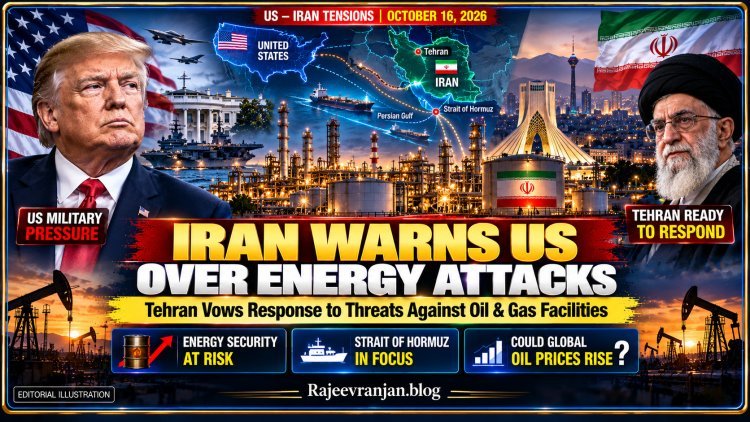

Tehran Draws Red Line Over Energy Facilities: Iran Promises Response to US Threats as Gulf Crisis Deepens
Iranian officials warn against targeting the country's critical energy infrastructure while Washington considers further military options. The escalating confrontation threatens to complicate diplomacy and unsettle international oil markets.
TEHRAN, OCTOBER 16, 2026 — A warning from Tehran has added another layer of uncertainty to an already volatile Middle East.
Iran has declared that it is prepared to respond if the United States threatens its oil, gas or other energy facilities, reinforcing its position that attacks on critical infrastructure would provoke retaliation.
Iranian Deputy Oil Minister Saeed Tavakoli, who also heads the National Iranian Gas Company, said on Friday that Tehran would respond promptly and appropriately to American threats against the country's energy installations.
His comments were reported by Russia's RIA Novosti news agency and subsequently carried by other media outlets.
The warning comes as US President Donald Trump continues to weigh possible military action against Iranian strategic facilities.
It also coincides with diplomatic efforts to address the prolonged confrontation over the Strait of Hormuz, one of the world's most important maritime energy corridors.
For international markets, the latest developments raise a troubling possibility: a conflict centred on military and nuclear concerns could further threaten the energy infrastructure on which millions of people depend.
The Iranian statement is a warning of possible retaliation, not confirmation that a new attack on an Iranian energy facility has occurred on October 16.
What Did Iran Say About US Threats?
Speaking amid heightened regional tensions, Tavakoli criticised Washington's military approach and its effect on international energy markets.
He argued that the conflict had already caused serious disruption to the global energy industry.
According to reports of his remarks, Iran intends to respond to threats against its energy facilities with measures it considers timely and appropriate.
The Iranian official did not publicly identify specific targets for a possible response or provide an operational timetable.
This distinction matters.
Although the statement signals Tehran's willingness to retaliate, it does not establish that Iran has authorised an immediate strike against any particular American installation.
The remarks are part of Iran's broader strategy of warning that attacks on its critical infrastructure could carry wider consequences.
For Washington, the message is intended to emphasise the potential costs of further military escalation.
For neighbouring countries, however, it raises concerns about the possibility of additional instability in the Persian Gulf.
Why Has the US–Iran Confrontation Intensified?
The latest warning follows months of military tensions between Iran and the United States.
The current conflict escalated after American and Israeli strikes against Iran began on February 28, 2026.
Subsequent military exchanges and disputes over maritime security created serious economic and diplomatic challenges.
Washington has repeatedly expressed concerns about Iran's nuclear programme and the security of international shipping.
Tehran, meanwhile, accuses the United States of violating international norms and threatening Iranian sovereignty.
The situation has become particularly sensitive because both countries have strategic interests in the Persian Gulf.
The United States maintains military forces and partnerships across the region.
Iran possesses significant military capabilities and occupies a geographically important position near major oil-exporting routes.
An escalation involving energy infrastructure could therefore affect countries far beyond the two directly involved in the confrontation.
Trump's Latest Warning Over Iran's Nuclear Facilities
On October 16, President Donald Trump said the United States might need to strike Iran's heavily fortified Pickaxe Mountain nuclear-related facility.
Speaking in an interview with Newsmax, Trump reiterated Washington's objective of preventing Iran from acquiring nuclear weapons.
He discussed the possibility of using conventional military force against facilities associated with Iran's nuclear programme.
However, Trump said he was not considering the use of nuclear weapons or deploying American ground troops.
His remarks demonstrate that military options remain part of Washington's approach even as diplomatic channels continue operating.
The possible targeting of a nuclear-related installation and threats against energy infrastructure are distinct issues. Neither should be presented as confirmation that a fresh strike has already been ordered.
US–Iran Tensions: Key Developments
| Date | Major Development |
|---|---|
| February 28, 2026 | US and Israeli strikes against Iran begin a new phase of military confrontation. |
| July 22 | Trump threatens strikes against Iranian bridges and power facilities in response to attacks on shipping. |
| August 6 | Reuters reports Iranian warnings that further US military action could expose regional infrastructure to retaliation. |
| October 1 | Reuters reports that Iranian officials are preparing broader retaliatory options if US attacks resume. |
| October 12 | Iran says it is reviewing Washington's response to proposals concerning the Strait of Hormuz. |
| October 16 | Iranian energy officials warn of a response to US threats against energy facilities. |
| October 16 | Trump raises the possibility of military action against Iran's Pickaxe Mountain facility. |
Note: These are separately reported developments. Their inclusion in a timeline does not establish that one event directly caused another.
Why Iran's Energy Infrastructure Is So Important
Iran's warning carries substantial economic significance because energy production remains central to its economy.
The country possesses major oil and natural gas resources, while its energy industry supports electricity generation, industrial activity and government revenue.
Important infrastructure includes oilfields, natural gas processing facilities, refineries, pipelines and export terminals.
Disruption to these facilities could affect domestic energy supplies and international markets.
However, not every energy installation carries the same strategic importance.
An attack on an administrative building, for example, would have different immediate consequences from the destruction of a major processing facility or export terminal.
For this reason, analysts distinguish between threats, confirmed physical damage and actual reductions in energy output.
Could Iran's Energy Exports Face Further Disruption?
Iran's energy exports have already faced severe pressure from sanctions and the US naval blockade.
Reuters reported on October 16 that some Iranian liquefied petroleum gas and jet-fuel shipments had continued despite American restrictions.
Maritime intelligence data indicated that several vessels had transported cargoes through alternative routes and ship-to-ship transfers.
The report also highlighted the significant reduction in Iran's regular crude exports.
These developments demonstrate how energy trade has become a major element of the confrontation.
Further military action against Iranian facilities could introduce additional risks, although the effect would depend on which installations were affected and whether shipments were disrupted.
Strait of Hormuz: The World's Energy Markets Remain Exposed
One of the most serious concerns surrounding the confrontation is the Strait of Hormuz.
The narrow waterway connects the Persian Gulf with the Gulf of Oman and provides access to international maritime routes.
Historically, approximately one-fifth of global oil consumption has passed through the strait, alongside substantial shipments of liquefied natural gas.
This makes it a critical route for international energy trade.
Any sustained disruption can influence shipping costs, oil availability and market confidence.
Why Are US–Iran Negotiations Stalled?
Iran and the United States have been communicating through diplomatic intermediaries, including Qatar and Pakistan.
However, negotiations have encountered major disagreements.
Tehran wants discussions to prioritise the reopening of the Strait of Hormuz and the restoration of maritime security.
Washington has sought to address Iran's nuclear programme as part of the broader negotiating process.
Iran argues that the American response has not adequately addressed its proposed conditions.
The two sides therefore remain divided over both the substance and sequence of negotiations.
On October 12, Iranian Foreign Ministry spokesperson Esmaeil Baghaei said Tehran was reviewing Washington's response and would communicate its position through intermediaries.
Although negotiations remain possible, a diplomatic breakthrough has not been confirmed.
Could US–Iran Tensions Push Global Oil Prices Higher?
Energy markets are sensitive to developments in the Middle East because the region plays a central role in oil and gas production.
Threats against energy infrastructure can increase concerns about supply disruptions.
However, financial-market reactions do not always move in the same direction.
For example, on October 16, oil prices declined after reports that Iranian officials remained open to diplomatic discussions.
MarketWatch reported that US West Texas Intermediate crude futures fell approximately 0.8% to $95.74 per barrel as diplomatic expectations helped ease some immediate concerns.
The movement illustrates how quickly market sentiment can change.
A warning of retaliation may increase uncertainty, while progress toward negotiations can reduce the perceived risk of a wider confrontation.
It would therefore be misleading to claim that oil prices rose solely because of Iran's latest warning without supporting market evidence.
Three Factors Energy Markets Will Watch
Actual damage to infrastructure: A confirmed attack on a major oil or gas facility could affect physical supply and increase pressure on prices.
Shipping conditions: Disruptions to tanker movements through the Strait of Hormuz could raise freight costs and insurance premiums.
Diplomatic developments: Renewed negotiations or agreements on maritime security could reduce uncertainty and support more stable trade.
For now, the warning primarily adds to geopolitical risk rather than establishing a new, measurable loss of energy production.
What Does the Iran–US Crisis Mean for India?
India is particularly exposed to changes in international energy markets because it imports most of the crude oil it consumes.
A major disruption to Middle Eastern supplies could affect the Indian economy through several channels.
Impact on Petrol and Diesel Prices
Higher international crude prices can increase the cost of importing petroleum.
However, domestic petrol and diesel prices depend on several additional factors, including taxation, refining costs, exchange rates and pricing decisions.
A temporary increase in international oil prices does not necessarily result in an immediate increase at every Indian fuel station.
Impact on the Indian Rupee
Crude oil imports generally require substantial foreign-currency payments.
If import costs increase significantly, demand for US dollars may also rise.
This can contribute to pressure on the rupee, particularly during periods of global financial uncertainty.
Nevertheless, currency movements depend on several economic factors, not energy prices alone.
Impact on Inflation
Higher energy costs can affect transportation, agriculture, manufacturing and logistics.
Businesses may pass some additional costs on to consumers.
The impact on inflation depends on the magnitude and duration of the price increase.
Impact on Indian Businesses
Indian companies involved in aviation, shipping, chemicals and other energy-intensive sectors may face higher operating costs if regional disruptions intensify.
Exporters and importers may also encounter changes in freight rates and delivery schedules.
For India, the central concern is whether the confrontation leads to a sustained disruption in energy supply rather than another temporary fluctuation in market sentiment.
What Does International Law Say About Attacks on Energy Plants?
The possibility of strikes against energy infrastructure raises important legal questions.
Under international humanitarian law, parties involved in armed conflict must distinguish between civilian objects and legitimate military objectives.
Civilian infrastructure cannot lawfully be attacked merely because damaging it would create economic pressure.
An energy facility may qualify as a military objective under certain circumstances, depending on its actual use and contribution to military operations.
Even when a target qualifies as a military objective, the attacking party must comply with the rules governing proportionality and precautions to protect civilians.
Energy infrastructure can be particularly sensitive because damage may disrupt electricity, drinking-water supplies, healthcare and other essential services.
Therefore, the legality of any specific strike depends on the circumstances and evidence.
Neither a general military warning nor the description of a facility as strategically important is sufficient to determine whether an attack would be lawful.
What Happens Next? Five Developments to Watch
The coming days could prove important for the direction of US–Iran relations.
First, Washington's military decisions: Any formal announcement concerning new operations against Iranian facilities would significantly change the situation.
Second, Iran's official response: Statements from Iran's senior political and military leadership may clarify whether Tehran intends to take additional measures.
Third, Strait of Hormuz negotiations: Diplomatic discussions involving Qatar and Pakistan could determine whether maritime security arrangements move forward.
Fourth, oil and gas exports: Tanker movements, sanctions enforcement and verified shipping data will provide a clearer picture of actual energy-market disruption.
Fifth, regional diplomacy: Gulf governments have a strong interest in preventing attacks that could threaten their own infrastructure and economic stability.
These developments will help determine whether the latest confrontation remains a war of warnings or progresses toward another significant military escalation.
Tehran's Warning Raises Stakes for Washington
Iran's latest warning underscores the fragile security environment surrounding the Persian Gulf.
By promising a response to threats against its energy facilities, Tehran is signalling that it considers critical infrastructure a central national-security concern.
Washington, meanwhile, continues to apply military and diplomatic pressure over Iran's nuclear programme and regional activities.
The confrontation has already affected international trade, shipping and energy markets.
However, the consequences of the latest warning remain uncertain.
No new attack on Iranian energy infrastructure has been established by the reports concerning the October 16 statement, and the precise nature of any future Iranian response remains unspecified.
For global markets, the most important distinction is between political threats and actual physical disruptions.
The danger is that a confrontation intended to deter further attacks could instead trigger another cycle of retaliation, placing regional stability and global energy security at greater risk.