


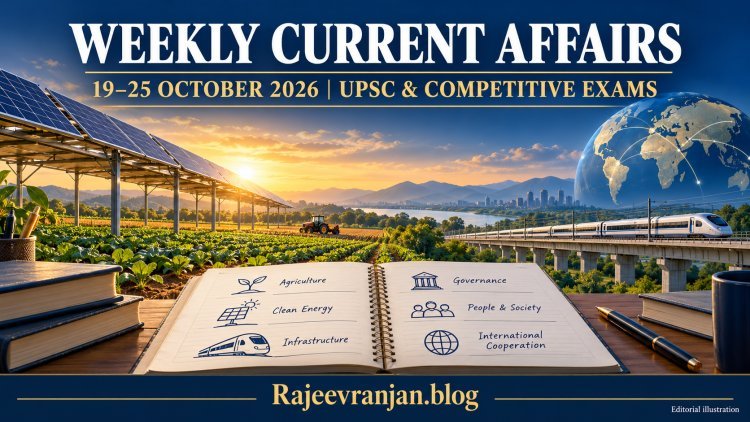
Weekly Current Affairs 19–25 October 2026 | UPSC
Revise current affairs for 19–25 October 2026 with source-linked UPSC notes, revision facts.
 Rajeev

1. India and Poland Set a Trade Target for 2030
Date: Joint statement issued 22 October; visit scheduled for 21–23 October 2026.
UPSC mapping: GS II—International relations.
India and Poland set a target of doubling bilateral trade by 2030. Their joint statement reaffirmed the Strategic Partnership and the Action Plan for 2024–2028. The trade figure is a future target, not an achieved increase.
Static background: A strategic partnership provides a framework for cooperation; individual commitments require follow-through.
Prelims focus: Poland; Strategic Partnership; Action Plan 2024–2028; trade target for 2030.
Mains analysis: Assess partnerships through actual investment, trade diversification and institutional cooperation. Diplomatic declarations alone do not establish economic results.
Source: India–Poland Joint Statement, PIB.
2. Agrivoltaics World Conference Concludes in India
Date: 21–23 October 2026.
UPSC mapping: GS III—Agriculture and renewable energy.
The seventh AgriVoltaics World Conference concluded on 23 October with emphasis on farmer-centred solutions. France is to host the eighth edition in 2027. The conference examined combining food production and solar generation on agricultural land.
Static background: Agrivoltaics combines agricultural activity and photovoltaic electricity generation on the same land.
Prelims focus: Agrivoltaics; MNRE; seventh edition; France as the next host.
Mains analysis: Potential benefits include additional farm income and more efficient land use. Adoption requires crop suitability, affordable structures, transparent contracts and protection of cultivators’ interests. A conference conclusion does not establish a new nationwide subsidy entitlement.
Source: Conference concluding release, PIB.
3. NSDC Makes Its Social Stock Exchange Debut
Date: 22 October 2026.
UPSC mapping: GS III—Skill development and development finance.
NSDC debuted on the NSE Social Stock Exchange. NABARD subscribed ₹4 crore to its maiden Zero Coupon Zero Principal issue. The announced programme aims to support international employment pathways for 600 rural youth from Madhya Pradesh, including language training for opportunities in Japan and Germany. These are intended beneficiaries, not confirmed overseas placements.
Static background: Social finance connects funding with social objectives; performance must be assessed against verifiable outcomes.
Prelims focus: NSDC; NSE Social Stock Exchange; NABARD; Zero Coupon Zero Principal instrument.
Mains analysis: Outcome-oriented financing needs transparent beneficiary selection, credible placement reporting and safeguards for workers.
Source: MSDE release, PIB.
4. Forest Rights Act Implementation Reviewed in Srinagar
Date: 23 October 2026.
UPSC mapping: GS II—Social justice; GS III—Forest governance.
The Ministry of Tribal Affairs held its third regional review conference on Forest Rights Act implementation in Srinagar. Seven states and Union Territories reviewed pending claims, recognition of rights, Community Forest Resource Rights and livelihood convergence. Time-bound action plans were emphasised.
Static background: The relevant legislation is the Scheduled Tribes and Other Traditional Forest Dwellers (Recognition of Forest Rights) Act, 2006.
Prelims focus: FRA, 2006; Ministry of Tribal Affairs; Community Forest Resource Rights.
Mains analysis: Implementation involves recognition of rights, administrative capacity and accessible procedures. A review meeting is not proof that pending claims have been resolved.
Source: Tribal Affairs release, PIB.
5. NHAI Introduces Toll-Plaza Feedback Feature
Date: 19 October 2026.
UPSC mapping: GS II—Citizen-centric governance.
NHAI introduced a Toll Plaza Feedback feature on the Rajmargyatra app, enabling highway users to share experiences and identify service concerns. The official announcement presents feedback as a tool for monitoring and improving service delivery.
Static background: Citizen feedback can reveal service deficiencies, but feedback collection and grievance resolution are separate stages.
Prelims focus: Rajmargyatra app; NHAI.
Mains analysis: Digital feedback systems require clear responsibility, accessible interfaces and demonstrable action. Launching a feature does not establish that every complaint will be resolved within a fixed period.
Source: NHAI release, PIB.
6. New Guidelines Address Highway Toll-Plaza Amenities
Date: 23 October 2026.
UPSC mapping: GS II—Public-service delivery; GS III—Infrastructure.
NHAI issued guidelines for upgrading, maintaining and monitoring toilet facilities and parking at National Highway toll plazas. They address technical assessment, cleaning, safety, accessibility, citizen feedback and performance accountability. Issuing guidelines does not mean every facility has already been upgraded.
Static background: Infrastructure quality depends on maintenance and operating standards as well as initial construction.
Prelims focus: NHAI; toll-plaza amenities; technology-enabled monitoring.
Mains analysis: Public amenities illustrate why procurement, maintenance budgets and independent inspection must work together.
Source: Guidelines announcement, PIB.
7. Two Railway Sections Dedicated in Madhya Pradesh
Date: 24 October 2026.
UPSC mapping: GS III—Transport infrastructure and regional development.
The 53-km Satna–Devendranagar and 65-km Rewa–Churhat railway sections were dedicated to the nation. A Devendranagar–Churhat passenger service was also flagged off. The official release confirms the inauguration rather than merely announcing a future event.
Static background: Rail connectivity can support passenger mobility and freight movement, but economic effects depend on utilisation and connecting infrastructure.
Prelims focus: Madhya Pradesh; combined length 118 km; Satna, Devendranagar, Rewa and Churhat.
Mains analysis: Evaluate infrastructure through affordability, service reliability and access to markets—not only kilometres constructed.
Source: Railways completion release, PIB.
8. Khet Bachao Abhiyan Launched
Date: 22 October 2026.
UPSC mapping: GS III—Sustainable agriculture.
The agriculture minister launched the nationwide Khet Bachao Abhiyan from Taraori in Karnal. The ministry’s advance announcement specified a campaign period from 22 October to 30 November, focusing on balanced fertiliser use, diversification and sustainable farming.
Static background: Balanced nutrient management seeks to match agricultural inputs with soil and crop needs.
Prelims focus: Karnal, Haryana; Rabi 2026; campaign period.
Mains analysis: Awareness campaigns need field advice, locally appropriate recommendations and evaluation of adoption. A campaign launch alone does not demonstrate improved soil health.
Sources: Launch release; campaign announcement.
9. United Nations Day Observed
Date: 24 October 2026.
UPSC mapping: GS II—International institutions.
The UN’s dated United Nations Day message stressed dialogue, cooperation and solidarity. The observance provides an opportunity to revise the organisation’s institutions and their functions.
Static background: The International Court of Justice is the UN’s principal judicial organ. It addresses disputes between states and authorised requests for advisory opinions.
Prelims focus: UN Day—24 October; ICJ—The Hague.
Mains analysis: Multilateral institutions provide forums for cooperation, but effectiveness depends on political support, resources and compliance. An observance is not a new treaty or institutional reform.
Source: UN institutional background and dated message link.
10. Social-Assistance Backgrounder Requires Careful Dating
Date: Backgrounder published 22 October; underlying Cabinet decision dated 14 October 2026.
UPSC mapping: GS II—Welfare and social protection.
A PIB backgrounder explained the continuation of the National Social Assistance Programme for 2026–27 to 2030–31, with an outlay of ₹53,428 crore, and its renaming as Pradhan Mantri Samajik Sahayata Yojana. The approval belongs to the preceding week; this week’s development is publication of the explanation.
Static background: An approved multi-year outlay is different from expenditure already incurred.
Prelims focus: Programme name; five-year period; approval versus publication date.
Mains analysis: Social protection should be assessed through coverage, accessibility, payment reliability and adequacy, alongside budget allocations.
Source: PIB backgrounder.
Quick Revision
| Topic | Remember |
|---|---|
| India–Poland | Doubling trade by 2030 is a target |
| Agrivoltaics | Farming and solar generation on shared land |
| NSDC | NSE Social Stock Exchange debut |
| FRA review | Srinagar; implementation review |
| Rajmargyatra | Toll-plaza feedback |
| Highway amenities | Guidelines do not establish completed upgrades |
| Madhya Pradesh rail | 53 km + 65 km = 118 km |
| Khet Bachao | Launched 22 October |
| UN Day | 24 October |
| Social assistance | Approval 14 October; backgrounder 22 October |