



US Midterm Elections 2026: Democrats Win Senate, House Projected to Flip
US midterm elections 2026: Democrats win the Senate and are projected to take the House, dealing a major setback to Trump's Republicans. Latest results.
 Rajeev
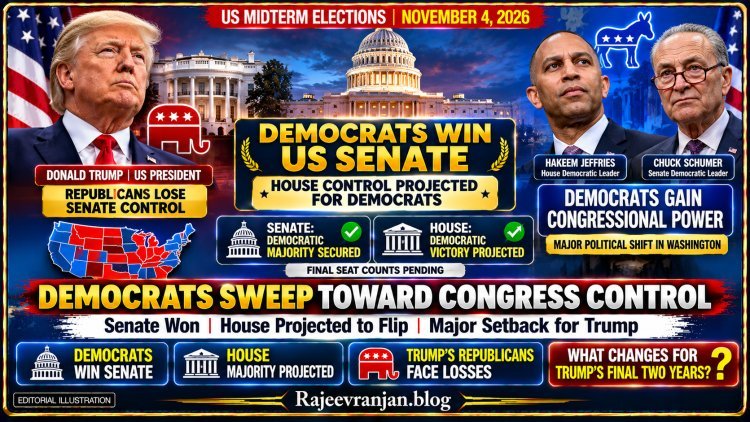

America's Political Map Turns Blue: Democrats Seize Senate as Trump's Republicans Face Sweeping Midterm Defeat
From Texas to South Carolina, states that helped power Donald Trump's political rise have delivered unexpected Democratic victories. With the Senate secured and the House projected to change hands, Washington is preparing for a dramatic shift in congressional power.
WASHINGTON | NOVEMBER 4, 2026
The most revealing moment of America's midterm election night did not come from Washington.
It came from Texas.
A state that Donald Trump carried comfortably in the 2024 presidential election elected a Democratic senator, delivering one of the clearest signs that the Republican Party was facing a difficult night.
Similar surprises followed in Kansas, South Carolina, Ohio and Iowa.
By early Wednesday, the political consequences were becoming unmistakable.
Democrats had won enough seats to secure control of the United States Senate. Major news organisations were also projecting that the party would take control of the House of Representatives.
The results represent a significant reversal for President Donald Trump, whose Republican Party entered the November 3 elections controlling both chambers of Congress.
For two years, Republican majorities had helped the president pursue his legislative priorities.
That arrangement is now set to change.
A Democratic-controlled Congress could intensify scrutiny of the administration, challenge its spending priorities and complicate its legislative programme.
But the election also sends a broader message about public concerns.
Voters repeatedly identified living costs, economic uncertainty and dissatisfaction with the country's direction as important factors shaping their decisions.
The results suggest that economic frustration and concerns about the administration's policies extended beyond traditional Democratic strongholds.
Democrats Secure the Senate as Republican Strongholds Flip
The most decisive development came in the Senate.
Before the election, Republicans held a 53–47 advantage, counting the two independents who caucused with Democrats on the Democratic side.
With 35 Senate contests on the ballot, Democrats needed significant gains to reverse that balance.
They achieved them.
The Associated Press called Democratic victories in several Republican-held states, including Texas, Kansas, South Carolina, Ohio, North Carolina and Iowa.
The party also won in Maine.
Together, these gains secured a Senate majority.
Some races remained unresolved as counting continued, meaning the eventual size of the Democratic majority was not yet final.
Nevertheless, the question of which party would control the Senate had been settled.
Senate Election Results: Latest Position
As of approximately 11:33 AM IST on November 4, Associated Press election data showed:
| Senate Status | Democrats and Allied Independents | Republicans |
|---|---|---|
| Seats won or carried over | 53 | 41 |
| Additional races leading | 3 | 3 |
| Majority required | 51 | 51 |
| Control | Democratic majority secured | No majority |
The figures include senators whose seats were not up for election. Leads are not counted as victories.
The final composition may change as remaining races are decided.
House of Representatives: Democrats Projected to Win Control
The Democratic Party also made major gains in the House of Representatives.
All 435 seats were contested.
Republicans entered election day holding a narrow majority, making the chamber vulnerable to relatively small shifts in voter support.
Democratic candidates won competitive districts in several states while also performing strongly in traditionally conservative areas.
Reuters reported on November 4 that major US news organisations had projected a Democratic House majority.
That projection represented another major setback for Republicans.
However, an important distinction remains between a projection of control and the number of races formally called.
House Results: Counting Continues
At approximately 11:50 AM IST, Associated Press data showed:
| House Status | Democrats | Republicans |
|---|---|---|
| Races called | 214 | 126 |
| Additional races leading | 42 | 47 |
| Seats needed for majority | 218 | 218 |
| Media projection | Democratic control projected | Republican majority projected lost |
A small number of districts had no reported leader at that snapshot.
The 42 Democratic leads were not yet official victories, so they must not be added to 214 and described as seats already won.
The Associated Press counting figures and news organisations' broader projections can therefore differ temporarily without being contradictory.
A projected majority is based on election data and assessments of remaining races, while a called race has been assigned a winner by the reporting organisation.
3. Live US Congressional Balance of Power
The following election figures are sourced from the Associated Press. They distinguish seats won from races where a party is currently leading.
US Senate — Democrats Secure Majority
US House — Democrats Projected to Gain Control
These election figures reflect the reported counting snapshots and may be superseded as additional races are called.
4. Texas Delivers One of the Election's Biggest Surprises
Among the most significant results was the Democratic victory in Texas.
James Talarico defeated Republican Ken Paxton in the state's US Senate election.
The result attracted particular attention because Texas has been a major Republican stronghold for decades.
Trump carried the state by approximately 14 percentage points in 2024.
For a Democrat to win a Senate election there just two years later represents an important political shift.
Talarico campaigned on economic concerns, political accountability and appeals to voters beyond the traditional Democratic base.
His victory demonstrated that Republicans faced difficulties even in states where they had previously enjoyed comfortable advantages.
Texas also delivered a major gubernatorial upset.
Democrat Gina Hinojosa defeated Republican Governor Greg Abbott.
The result reinforced the scale of the state's political change.
However, one election does not necessarily establish that Texas will permanently become a Democratic state.
Long-term political realignments require sustained electoral evidence.
5. Kansas, South Carolina and Ohio Add to Republican Losses
The Democratic gains extended well beyond Texas.
Kansas: Adam Hamilton Wins
Democrat Adam Hamilton defeated Republican Senator Roger Marshall.
The outcome was especially notable because Kansas has historically been strongly Republican in federal elections.
Hamilton's campaign placed emphasis on affordability, political accountability and dissatisfaction with Washington.
South Carolina: Annie Andrews Wins
In South Carolina, Democrat Annie Andrews defeated Republican Darline Graham.
The state voted strongly for Donald Trump in 2024.
The Democratic victory therefore represented another important departure from recent electoral patterns.
Ohio: Sherrod Brown Returns
Former Democratic Senator Sherrod Brown defeated Republican Jon Husted.
Brown's return to the Senate highlighted the importance of economic concerns in a state where Republicans had gained substantial support in recent years.
Iowa: Josh Turek Flips a Senate Seat
Democrat Josh Turek defeated Republican Ashley Hinson in Iowa's open Senate contest.
The victory added another Republican-held seat to the Democratic column.
These results collectively demonstrate why the Senate majority shifted.
Democrats did not simply defend their traditional strongholds.
They won competitive contests in states that Republicans had expected to remain within their political coalition.
6. Why Did Republicans Perform So Poorly?
The election result cannot be explained by one issue alone.
However, voter surveys and campaign reporting identify several important concerns.
Rising Living Costs
Household expenses remained a major issue for American voters.
Food, housing, energy and healthcare costs featured prominently in campaigns.
Many voters expressed frustration that their financial circumstances had not improved as expected.
Economic dissatisfaction often creates difficulties for the party holding the presidency.
The War With Iran
The continuing conflict involving Iran also influenced public attitudes.
The war raised concerns about foreign policy, government spending, energy prices and America's international commitments.
Democratic candidates frequently criticised the administration's handling of the conflict.
Republicans defended the administration's national-security priorities and argued that their policies were intended to protect American interests.
Tariffs and Trade Policy
Trump's trade policies were another point of disagreement.
Supporters argue that tariffs can protect domestic industries and encourage investment in American manufacturing.
Critics contend that tariffs can raise costs for businesses and consumers, particularly when importers pass additional expenses on to buyers.
The election occurred amid continuing debate over these economic effects.
Public Trust and Government Accountability
Voters also raised questions about the conduct of government, political leadership and institutional accountability.
Democrats campaigned on the need for stronger congressional oversight.
Republicans argued that Democratic victories could lead to investigations and political confrontation rather than productive policymaking.
The results suggest that concerns about affordability and governance resonated with a substantial number of voters, including some who had previously supported Republicans.
7. What Has Donald Trump Said About the Results?
President Trump acknowledged Democratic victories but rejected the suggestion that the outcome represented a personal rejection of his presidency.
In comments reported by the Associated Press, Trump congratulated Democrats for campaigning effectively.
However, he also criticised Republican candidates and argued that their defeats should not be attributed solely to him.
The president maintained that his administration had delivered significant achievements during its first two years.
His response reflects an important distinction between how the parties interpret the election.
Democrats view their victories as evidence that Americans want a change in direction.
Trump and his supporters argue that individual candidates, local conditions and campaign strategies also contributed to the outcomes.
Both perspectives will influence the political debate in the coming months.
But the institutional consequence is clear: the president will face a Congress less willing to approve his agenda without challenge.
8. What Changes if Democrats Control Both Houses?
Control of Congress provides considerable institutional power.
However, it does not mean Democrats automatically control the executive branch.
Donald Trump remains president.
The Democrats' ability to influence policy will depend on congressional rules, the size of their majorities and the president's constitutional powers.
Congressional Investigations
Democratic-controlled committees could initiate investigations into executive-branch decisions.
These may involve government spending, federal contracts, national-security policies and administrative conduct.
Congressional committees possess oversight powers, including the ability to request documents and conduct hearings.
Government Spending
Congress plays a central role in approving federal spending.
A Democratic majority could challenge budget proposals and negotiate changes to spending priorities.
Disagreements could lead to difficult negotiations over government funding.
Immigration Policy
Immigration is likely to remain a major area of political disagreement.
Democrats may seek greater oversight of enforcement practices and changes to immigration-related legislation.
The president, meanwhile, retains significant executive responsibilities.
Foreign Policy
Congress can influence foreign policy through legislation, spending authorisations and oversight.
However, the president continues to exercise important powers over diplomacy and national-security decisions.
Presidential Veto
Trump can veto legislation passed by Congress.
Overriding a presidential veto generally requires a two-thirds majority in both chambers.
Therefore, Democrats could block many Republican legislative proposals without necessarily being able to enact their entire programme.
9. Could Hakeem Jeffries Become House Speaker?
Democratic House leader Hakeem Jeffries is positioned to become the next Speaker if the party's projected majority is confirmed and House members elect him.
Jeffries would become the first Black Speaker of the US House of Representatives.
However, the position is not awarded automatically to the leader of the winning party.
Members of the House must elect the Speaker through the chamber's formal voting process.
A Democratic majority would make Jeffries the leading candidate.
The size of that majority could influence how easily he manages legislation and internal party disagreements.
In the Senate, Democratic leaders will also need to organise committee assignments and leadership positions for the new Congress.
These changes will determine how congressional oversight and legislative priorities are managed.
10. US Midterms 2026: Major Election Highlights
| Development | Latest Status |
|---|---|
| Election held | November 3, 2026 |
| Senate majority | Democrats secured |
| House majority | Democratic control projected |
| Texas Senate | James Talarico wins |
| Kansas Senate | Adam Hamilton wins |
| South Carolina Senate | Annie Andrews wins |
| Ohio Senate | Sherrod Brown wins |
| Iowa Senate | Josh Turek wins |
| Maine Senate | Democratic gain reported |
| Texas Governor | Gina Hinojosa defeats Greg Abbott |
| Hakeem Jeffries | Positioned to become House Speaker |
| Donald Trump | Remains US President |
| Remaining contests | Counting continues |
| Final certified nationwide seat totals | Not yet available |
The election results are based on reporting and race calls available on November 4.
11. What Does the Election Mean for India?
The US midterm results are significant for India because of the extensive economic and strategic relationship between the two countries.
However, the practical consequences will depend on future policy decisions rather than the election result alone.
Trade and Tariffs
India and the United States maintain substantial trade relationships.
A Democratic Congress may scrutinise aspects of Trump's tariff policies.
However, changes to trade policy can involve executive powers, existing legislation and negotiations with trading partners.
The election does not automatically eliminate existing tariffs.
Technology and Artificial Intelligence
American technology companies maintain major operations and commercial relationships in India.
Congressional decisions involving AI regulation, semiconductor exports, immigration and technology investment could influence the business environment.
Indian IT Professionals
Changes to employment-based immigration policies may be important for Indian technology workers and US employers.
But control of Congress does not immediately change visa requirements.
Defence Cooperation
India and the United States cooperate on defence technology, security and regional strategic issues.
These relationships have developed under administrations of both major American political parties.
Consequently, the election is unlikely by itself to end defence cooperation.
Global Financial Markets
Political developments in Washington can influence expectations about government spending, taxation and financial regulation.
These expectations may affect international markets.
However, investors should avoid assuming that a Democratic Congress will automatically cause US stocks, the dollar or Indian markets to rise or fall.
Market reactions depend on numerous economic factors.
12. What Happens Next?
The next stage involves completing vote counting and confirming the final distribution of seats.
Some closely contested districts may require additional time to process mail ballots and other outstanding votes.
Individual results can also face recounts or legal challenges under applicable state laws.
Once results are certified, the newly elected lawmakers will prepare for the 120th Congress.
The new Congress is scheduled to begin its term in January 2027.
Until then, the existing Congress continues to exercise its responsibilities.
Political attention will increasingly turn towards congressional leadership elections, committee organisation and the legislative agenda for 2027.
The results will also shape how both parties prepare for the 2028 presidential election.
For Republicans, the challenge will be understanding why support weakened in several previously reliable states.
For Democrats, the challenge will be converting electoral gains into effective governance while managing disagreements within the party.
13. Conclusion: A Major Turning Point in Trump's Second Presidency
The 2026 US midterm elections have delivered a significant political setback to President Donald Trump and the Republican Party.
Democrats have secured control of the Senate and are projected to take the House of Representatives.
Their victories in states including Texas, Kansas, South Carolina, Ohio and Iowa show that dissatisfaction with the administration extended beyond traditional Democratic areas.
Voters expressed concerns about living costs, government accountability and foreign policy.
The result could transform Washington's political landscape during the remaining two years of Trump's presidency.
But a Democratic Congress would not automatically mean the end of the president's policy agenda.
Instead, it would create a new period of negotiations, oversight and potentially sharper political confrontation.
The 2026 midterms have changed the balance of congressional power. The next question is whether America's divided political leadership can turn that change into effective government.