


Prayagraj Cash Mystery: ₹3.20 Crore Found at Rajesh Yadav's House, Pune Link Probed
Prayagraj police recover ₹3.20 crore buried in blue drums at Rajesh Yadav's property. Investigators examine a Pune connection and unexplained wealth.
 Rajeev

Three Blue Drums, ₹3.20 Crore and a Pune Connection: The Mystery Unfolding in Prayagraj
An ordinary village property has become the centre of an extraordinary financial investigation. With crores of rupees recovered from underground drums, investigators are following a trail stretching from rural Uttar Pradesh to Maharashtra.
PRAYAGRAJ | NOVEMBER 1, 2026
It began with a dispute. Then came a tip-off. What police eventually discovered beneath the ground transformed a local investigation into a mystery involving crores of rupees.
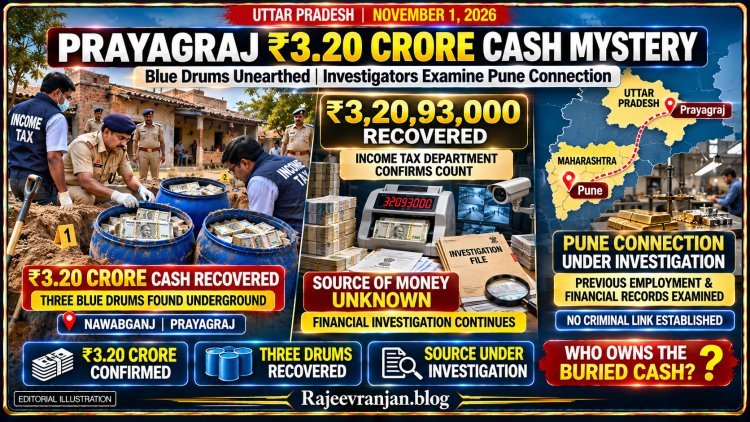
In Baraipur Ramnagar village, under Prayagraj's Nawabganj police station limits, investigators unearthed three blue plastic drums filled with bundles of ₹500 currency notes.
The cash had been concealed beneath the ground at a property associated with brothers Rajesh Yadav and Rakesh Yadav.
After several days of counting, the Income Tax Department confirmed that the recovered currency totalled ₹3,20,93,000.
But while the amount is now known, its origin remains unresolved.
Investigators are examining the brothers' earlier employment in Pune, their financial activities after returning to Prayagraj and their acquisition of substantial property in recent years.
Documents recovered during further excavation could provide new leads.
At the centre of the investigation is a question that remains unanswered:
Who owned the money, where did it come from, and why was it buried underground?
How Police Discovered the Buried Cash
The investigation began after a dispute involving members of the Yadav family and a neighbour.
On October 21, a neighbour named Abhishek Kumar filed a complaint at Nawabganj police station alleging assault by Rajesh Yadav and members of his family.
During the subsequent investigation, police reportedly received information suggesting that a substantial amount of money had been hidden at the property.
Acting on the information, officers visited the village on October 28.
The search led investigators to three blue drums concealed beneath the ground.
Inside were bundles of ₹500 notes wrapped in cloth and protective material.
The recovery was documented, and the drums were secured before the Income Tax Department became involved.
Initial reports suggested that the recovered amount could be substantially higher.
Some early estimates ranged from ₹3 crore to ₹10 crore.
However, these estimates were superseded once the currency was counted.
The confirmed amount recovered from the three drums is ₹3,20,93,000.
That figure was reported following the completion of the counting process.
Pune Connection Becomes a Major Focus
One of the most important developments concerns the brothers' earlier employment in Maharashtra.
According to investigators, Rajesh and Rakesh Yadav previously worked in Pune before returning to their village during the Covid-19 pandemic.
Officials are examining reports that they worked at a bullion trader's workshop.
The brothers' financial history has attracted scrutiny because of property acquisitions and business investments made after their return.
Investigators are trying to determine whether any transactions involving individuals or businesses in Pune can explain the recovered cash.
According to regional reporting, the brothers referred during questioning to a Pune businessman who might be connected to the money.
However, that account has not been independently substantiated.
The reported businessman's identity and precise role remain unclear.
Police are also exploring whether financial documents and available communication records can help reconstruct transactions from previous years.
The difficulty is that some of the relevant events may have occurred several years ago.
A previous employment connection to Pune is not, by itself, evidence of criminal activity.
Investigators must establish the actual source and ownership of the money through records and other verifiable evidence.
A Sudden Change in Financial Circumstances Raises Questions
Residents of Baraipur Ramnagar reportedly told investigators that the family's financial position changed significantly after the brothers returned from Maharashtra.
Local reports described purchases of agricultural land, vehicles and commercial property.
According to information attributed to investigators, approximately 22 bighas of land were acquired across three locations in the Nawabganj area over several years.
The reported purchases were said to be worth more than ₹10 crore.
The brothers also reportedly invested in steel and cement-related businesses.
Other reported acquisitions included a residential property, agricultural vehicles and business equipment.
Authorities are examining whether these assets can be linked to legitimate earnings, loans, business income or other sources.
However, the existence of property or business investments does not establish that the assets were acquired illegally.
The key issue is whether financial records can explain the transactions.
Investigators Recover Documents During Further Excavation
The investigation continued after the initial cash recovery.
On October 31, Income Tax Department officials recovered three packets containing documents from the property.
The documents had reportedly been sealed in plastic to protect them from deterioration.
Officials believe they may help establish aspects of the financial trail.
Assistant Director (Investigation) Abhay Kumar Sonker, who has been supervising the Income Tax operation, said the inquiry remained at an early stage.
Investigators are examining the records alongside statements obtained from the brothers.
Police and Income Tax officials have also continued searching the property for additional concealed items.
The investigation may extend to another house associated with Rakesh Yadav.
Officials are considering questioning additional family members where necessary.
No final conclusion about the origin of the recovered money has been announced.
Prayagraj Cash Recovery: Key Facts
| Detail | Latest Information |
|---|---|
| Location | Baraipur Ramnagar, Prayagraj |
| Initial Recovery | October 28, 2026 |
| Containers | Three blue drums |
| Confirmed Cash | ₹3,20,93,000 |
| Currency | ₹500 denomination |
| People Questioned | Rajesh and Rakesh Yadav |
| Agencies | Police and Income Tax Department |
| Pune Connection | Under investigation |
| Financial Documents | Three packets recovered |
| Alleged Counterfeit Notes | Not established |
| Source of Cash | Unknown |
| Investigation Status | Continuing |
Why Are Investigators Examining the Cash?
Recovering a large amount of cash does not automatically prove that a crime has occurred.
However, authorities may investigate whether such money has a legitimate, documented source.
The circumstances of this case have raised several questions.
The cash was concealed underground rather than held in an ordinary bank account or business location.
Its reported ownership has not been consistently explained.
The brothers' financial history and reported property purchases also require examination.
Investigators may assess whether the money represents legitimate savings, business proceeds, undisclosed income, property transactions or funds connected to an alleged offence.
Each possibility requires evidence.
The Income Tax Department can examine unexplained cash and financial records under applicable law.
If evidence of another offence emerges, the relevant authorities may pursue further proceedings.
However, questioning a person or examining their finances is not equivalent to establishing guilt.
Is the Recovered Money Fake Currency?
This is an important distinction in the developing story.
Some discussions have described the Prayagraj investigation as a counterfeit-currency case.
However, the reporting reviewed does not establish that the ₹3.20 crore recovered from the Yadav property consists of fake banknotes.
The notes have been described as bundles of ₹500 currency.
The central investigation concerns their source, ownership and possible financial irregularities.
There have been separate counterfeit-currency investigations in Prayagraj and Pune during 2026.
For example, Pune Police reported a separate racket in late October involving the seizure of counterfeit ₹500 notes.
But no verified evidence currently connects that case to the cash recovered at the Yadav property.
The existence of separate investigations in the same cities does not establish a criminal connection between them.
Until police identify a counterfeit-currency link supported by evidence, the recovered ₹3.20 crore should be described as unexplained or suspected unaccounted cash—not fake currency.
Why the Financial Trail Matters More Than the Discovery
The dramatic recovery of the drums has attracted public attention.
But investigators now face a much more complex task.
They must reconstruct financial activity over several years.
That could involve examining employment records, bank accounts, property registrations, business transactions and available communications.
Investigators may also need to determine whether the money belonged to the brothers or another individual.
If a Pune-based businessperson is found to have a connection to the recovered cash, that relationship would need to be established through reliable documentation.
The case could involve financial irregularities.
Alternatively, some transactions may have legitimate explanations.
At present, the available evidence does not justify treating either possibility as established.
What Happens Next?
The investigation is expected to focus on several unresolved questions.
First, authorities must identify the origin of the ₹3.20 crore.
Second, they must establish whether the documents recovered from the property support any particular explanation.
Third, investigators will examine the reported Pune financial connection.
Fourth, officials may assess the brothers' property purchases and business investments.
Finally, police and Income Tax authorities must determine whether the available evidence establishes an offence requiring further legal action.
The inquiry remains open.
Conclusion: The Biggest Mystery Is Still Unsolved
The discovery of ₹3.20 crore buried beneath a Prayagraj property has raised serious questions about the origin and ownership of the money.
Investigators have confirmed the cash recovery and are examining financial links extending to Pune.
The case has also brought attention to the brothers' reported property acquisitions and business activities after returning to their village.
But several crucial facts remain unknown.
No verified source of the money has been established.
The reported Pune connection has not yet produced a publicly confirmed explanation.
And claims that the recovered currency was counterfeit remain unsupported.
The discovery of the money made headlines. Establishing who owned it—and why it was hidden—will determine what this investigation ultimately reveals.