



Houthi Missile Attack on Aden Presidential Palace and Airport: Yemen Latest
Yemen's military says Houthis launched ballistic missiles at Aden's presidential palace and airport on October 30. Latest on casualties and regional tensions.
 Rajeev
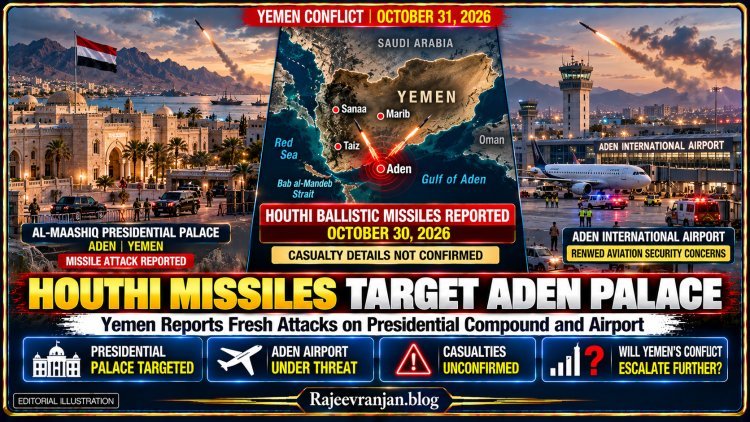

Aden Under Fire Again: Houthi Missile Attacks Put Yemen's Government Headquarters and Airport at Risk
The latest reported missile attacks have renewed questions about security in Yemen's temporary seat of government. As fighting intensifies, Aden's presidential compound and international airport have become central to a conflict whose consequences extend far beyond the battlefield.
ADEN, YEMEN | OCTOBER 31, 2026
For a city already struggling with years of conflict, the sound of another missile warning carries a familiar fear.
Aden, the southern port city that serves as the headquarters of Yemen's internationally recognised government, has again become a target in the country's escalating war.
On Friday, October 30, Yemen's government armed forces reported that Houthi rebels had launched ballistic missiles towards two of the city's most important facilities: Aden International Airport and the Al-Maashiq Presidential Palace.
The announcement came from military spokesperson Majed Abdullah Al-Nuzaili, who accused the Iran-aligned Houthi movement of carrying out the attacks.
However, the military statement did not establish how many missiles struck their intended targets or provide confirmed details about damage and casualties.
That uncertainty is particularly important because Aden has experienced several separate missile attacks during October, including a deadly assault on the presidential palace earlier in the month.
The latest developments underline the vulnerability of the southern government's headquarters as fighting between Houthi forces and the Saudi-backed government intensifies.
They also raise concerns about the safety of civilian aviation, humanitarian operations and essential infrastructure.
What Happened in Aden on October 30?
According to Yemen's military, Houthi forces targeted Aden International Airport and the Al-Maashiq Presidential Palace complex with ballistic missiles.
The presidential compound serves as a major administrative and security centre for the internationally recognised government.
The airport is one of the country's most important links to international transportation and humanitarian assistance.
Both locations have strategic significance.
The government did not immediately provide a verified casualty figure for the latest reported attacks.
It also remained unclear whether every missile reached its intended target.
The distinction between a missile being launched, intercepted or striking a facility is essential when assessing the consequences of a military incident.
As of the latest reports reviewed, there was no confirmed death toll from the October 30 attacks.
The new allegations follow a separate strike on Aden airport on October 28 that injured civilians and disrupted aviation services.
Yemen's Presidential Palace Was Already Attacked Earlier This Month
The October 30 incident was not the first reported attack on the Al-Maashiq Presidential Palace during the latest escalation.
On October 15, Houthi forces launched missiles at the presidential compound.
Yemeni authorities said five people were killed and 16 injured.
The casualties included security personnel and civilian employees working at the complex.
Two members of the prime minister's security detail were among those killed.
Yemen's Prime Minister Shaya al-Zindani and other government ministers were reported to be unharmed.
The attack was particularly significant because the compound houses senior government offices in Aden.
Yemeni officials said five missiles had been fired at the complex.
Houthi military spokesperson Yahya Saree said the group's intended target was a Saudi military operations headquarters allegedly operating within the compound.
That explanation was not independently verified.
The internationally recognised government described the incident as an attack on its headquarters.
The five deaths and 16 injuries belong to the October 15 attack. They must not be attributed to the separate October 30 incident.
3. Aden Missile Attacks: Key Developments
| Date | Reported Development | Casualty Information |
|---|---|---|
| October 15 | Houthi missiles strike Al-Maashiq Presidential Palace | 5 killed, 16 injured |
| October 16 | Further attacks on Aden airport reported | Separate incident |
| October 28 | Airport attacked following Houthi evacuation warning | 2 civilians reportedly injured |
| October 29 | Aden airport reopens following emergency repairs | No new toll established |
| October 30 | Yemeni military reports missile attacks targeting airport and presidential palace | No casualties confirmed |
| October 31 | Authorities continue assessing the security situation | Further verification required |
Sources: Reuters, Associated Press and Yemeni government statements published in October 2026.
4. Why Is Aden So Important to Yemen?
To understand the significance of the latest attacks, it is necessary to understand Yemen's divided political geography.
Yemen has been experiencing a prolonged conflict since Houthi forces seized control of the capital, Sanaa, in 2014.
The internationally recognised government subsequently established its principal base in Aden.
Since then, the southern port city has played a central role in government administration, diplomacy and security coordination.
Aden also serves as an important transportation and commercial centre.
Its airport supports international travel, humanitarian movements and the arrival of essential supplies.
This makes attacks against government facilities and transport infrastructure particularly consequential.
An assault on the presidential compound can threaten government operations.
An attack on the airport can interrupt movement into and out of southern Yemen.
For civilians, such disruptions may complicate access to medical care, international flights and humanitarian assistance.
Why the Presidential Palace Matters
The Al-Maashiq complex is not simply a symbolic government building.
It houses important administrative and security functions.
Its location gives it political significance in the contest between Houthi forces and the internationally recognised government.
Attacks on such facilities can increase pressure on government institutions and force authorities to strengthen security arrangements.
However, the latest reports do not establish that the October 30 strike incapacitated the government or resulted in the capture of the presidential compound.
5. Aden Airport Becomes Another Flashpoint
The airport has experienced repeated security threats during October.
On October 28, Houthi forces attacked Aden International Airport after issuing a warning for people to evacuate.
Residents reported hearing an explosion near the facility.
Authorities temporarily suspended air traffic.
The Houthi movement said its warning followed what it described as the arrival of a Saudi military cargo aircraft carrying weapons.
That allegation was not independently established.
The airport attack caused damage and reportedly injured two civilians.
Emergency repairs were subsequently carried out.
According to reporting published on October 31, the airport reopened on October 29 before the latest missile attacks were reported.
The pattern of repeated strikes has raised serious concerns about aviation safety.
For Yemen, where transportation infrastructure has suffered years of disruption, another prolonged airport closure could worsen existing humanitarian difficulties.
6. Who Are the Houthis, and Why Are They Attacking Aden?
The Houthis, formally known as Ansar Allah, are a political and armed movement that emerged in northern Yemen.
The group seized Sanaa in 2014 and subsequently expanded its territorial control.
The conflict brought in a Saudi-led coalition supporting Yemen's internationally recognised government.
Iran has maintained ties with the Houthi movement, which receives political and military support from Tehran, according to Western and regional government assessments.
The Houthis have established their own governing structures in areas under their control.
They possess missiles, drones and other military capabilities.
In the latest escalation, the movement has claimed that certain government and coalition facilities are being used for Saudi military operations.
Yemen's internationally recognised government disputes the Houthis' justification for attacks against government and civilian infrastructure.
These competing accounts must be assessed independently.
The presence of a military objective, even if verified, would not remove the obligations imposed by international humanitarian law concerning civilian protection.
7. Saudi Arabia's Role in the Escalating Conflict
Saudi Arabia remains a major participant in Yemen's security situation.
The Saudi-led coalition has supported government forces in their operations against the Houthis.
The coalition has also conducted airstrikes against Houthi military facilities and weapons infrastructure.
In recent weeks, Saudi authorities have reported missile and drone threats against airports, military positions and critical infrastructure.
The Houthis, meanwhile, have accused Saudi forces of conducting attacks against territory under their control.
These developments have raised fears that Yemen could become an increasingly dangerous front in the wider Middle East conflict.
The latest strikes on Aden come amid growing regional tensions involving Iran and its adversaries.
However, the available reporting does not establish that Iran directly ordered the October 30 attack on Aden's presidential palace.
Any such allegation would require additional evidence.
8. The Humanitarian Consequences of Renewed Fighting
For Yemen's population, the military escalation comes at an especially difficult time.
More than a decade of conflict has damaged infrastructure, disrupted public services and contributed to widespread displacement.
Access to healthcare, food, clean water and reliable electricity remains limited in many areas.
Renewed fighting threatens to worsen these conditions.
Civilian Aviation and Medical Access
Airports are especially important in countries with severely damaged transportation networks.
Interruptions can affect people seeking medical treatment abroad and families trying to travel between countries.
They can also complicate humanitarian logistics.
Displacement Risks
Missile attacks and nearby fighting may force residents to leave vulnerable neighbourhoods.
Displacement can place additional pressure on temporary shelters and host communities.
Essential Services
Damage to roads, electricity networks or communications infrastructure can hinder everyday life and emergency response.
Humanitarian Aid
International organisations rely on safe transportation routes to deliver assistance and move staff.
Repeated attacks near transport facilities can create uncertainty even when aid operations are not directly targeted.
The latest military escalation therefore raises concerns extending beyond the immediate strike locations.
9. Could the Conflict Threaten Red Sea Shipping?
Yemen occupies a strategically important position near the Bab al-Mandeb Strait.
The waterway connects the Red Sea with the Gulf of Aden and forms part of a major international shipping route.
Commercial vessels travelling between Europe and Asia frequently use this corridor.
The Houthis have previously attacked commercial shipping in the Red Sea region.
Renewed fighting in western and southern Yemen could increase concerns about maritime security.
However, the October 30 attacks on Aden's presidential palace and airport do not themselves establish that Bab al-Mandeb has been closed.
Any claim of a shipping shutdown would require confirmation from maritime authorities and commercial operators.
A prolonged disruption could affect shipping costs, insurance premiums and delivery schedules.
The scale of any impact would depend on the intensity and geographical spread of the conflict.
10. Why the Latest Attacks Matter Internationally
The Aden missile attacks demonstrate how Yemen's internal conflict remains connected to wider regional security developments.
The internationally recognised government is supported by Saudi Arabia.
The Houthis maintain ties with Iran.
These relationships make developments in Yemen important to policymakers across the Middle East.
A further escalation could complicate regional diplomacy and increase risks to civilian infrastructure.
It could also place additional pressure on humanitarian organisations already responding to emergencies.
For India and other countries with commercial interests in the region, instability around the Red Sea and Gulf of Aden may affect shipping and international trade.
However, it would be premature to attribute specific changes in global oil prices or Indian import costs directly to the October 30 missile attacks without supporting market evidence.
11. What Happens Next?
The immediate priority is establishing the consequences of the latest reported attacks.
Several questions remain unanswered.
Did the missiles strike their intended targets?
The initial Yemeni military announcement did not provide a complete assessment of impacts.
Were there casualties?
No confirmed casualty figure was reported for October 30.
Was Aden airport damaged again?
Authorities have not provided a complete verified assessment of the latest incident.
Were government leaders present at the palace?
The available October 30 reporting does not establish the location or safety status of particular officials during that attack.
Will further attacks follow?
The possibility of additional fighting remains a concern, but no specific future strike can be predicted reliably.
Further statements from Yemeni authorities, humanitarian organisations and independent observers will be important.
12. Conclusion: Aden Faces Renewed Danger as Yemen's War Intensifies
The latest reported Houthi missile attacks on Aden International Airport and the Al-Maashiq Presidential Palace mark another escalation in Yemen's conflict.
The October 30 announcement follows earlier strikes on both facilities, including the deadly October 15 palace attack that killed five people and injured 16.
The repeated targeting of important government and transportation infrastructure highlights the risks facing Aden.
For the internationally recognised government, the attacks raise questions about security and the ability to maintain administrative operations.
For civilians, the concerns are more immediate: safety, transportation, medical access and the availability of essential services.
The competing military claims also underline the importance of independent verification.
Aden's latest missile scare is not only a test of the government's security. It is another reminder that Yemen's civilians continue to bear the consequences of a conflict that has lasted for more than a decade.