


Netanyahu Says Israeli Army Ready for Major West Bank Operation After Hebron Attack
Netanyahu says Israel's army is ready for a massive West Bank operation after two soldiers are killed near Hebron. Latest on lockdowns and civilian risks.
 Rajeev

Netanyahu Warns of Sweeping West Bank Offensive as Hebron Attack Kills Two Israeli Soldiers
Israel's prime minister says the military is prepared for an operation on a scale not seen in the occupied territory for decades. His warning follows a deadly gun battle near Hebron and comes just days before a national election, as Palestinian communities face the prospect of expanded military raids, movement restrictions and displacement.
HEBRON, OCTOBER 23, 2026 —
The road into Hebron was already under heavy security when Israeli Prime Minister Benjamin Netanyahu delivered a warning that could signal a significant escalation in the occupied West Bank.
Standing in the aftermath of a deadly shooting involving Israeli soldiers and Palestinian gunmen, Netanyahu said the Israel Defence Forces (IDF) were prepared for an extensive military operation across the territory.
The proposed campaign, he suggested, could be the largest Israeli operation in the West Bank since Israel occupied the territory during the 1967 Arab–Israeli War.
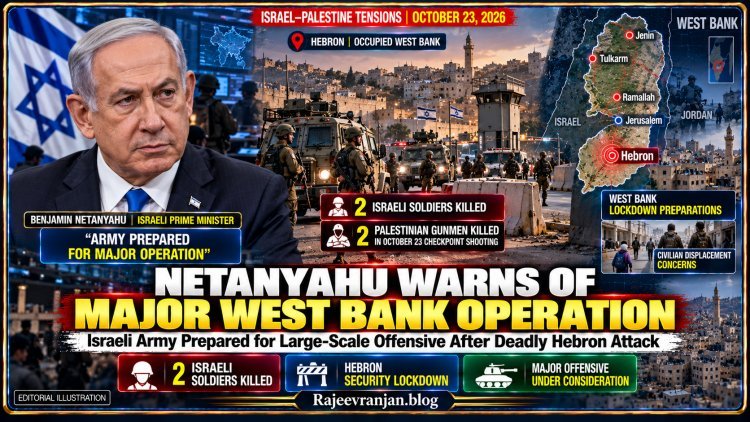
The announcement came after two Palestinian gunmen killed two Israeli soldiers and wounded three others near Hebron on Friday morning.
Israeli forces subsequently shot and killed both attackers.
Netanyahu visited the area with Defence Minister Israel Katz and outlined plans for intensified military activity, including the evacuation of residents from a Hebron neighbourhood, house-to-house searches and the destruction of infrastructure Israel identifies as supporting armed groups.
The prime minister also ordered security forces to impose restrictions around Hebron and prepare for a broader closure of the occupied West Bank.
However, the timing and full geographical scope of the proposed large-scale military operation have not yet been announced.
The developments mark a potentially significant moment in a territory already affected by years of Israeli military operations, Palestinian attacks and violence involving Israeli settlers.
What Did Netanyahu Say About the West Bank Operation?
During his visit to Hebron, Netanyahu said Israel had developed plans for a major military campaign.
Referring to the occupied West Bank by the Israeli government's preferred geographical terminology, Judea and Samaria, he described an operation potentially larger than previous campaigns.
"The IDF is prepared to carry it out," Netanyahu said, while explaining that the government would determine when to begin.
He also indicated that the planned operation could resemble Israeli military campaigns conducted in refugee camps in the northern West Bank.
According to Netanyahu, security forces would enter the neighbourhood where the attackers allegedly lived, evacuate residents, search buildings and confiscate weapons.
He described the objective as dismantling militant infrastructure and preventing further attacks.
The Israeli government has presented its response as a national-security measure.
However, the proposals have raised serious questions about how many Palestinian residents could be displaced and what restrictions might be imposed on civilian life.
No publicly confirmed timetable has been provided for the broader operation.
What Happened Near Hebron?
Friday's developments began with a shooting near a military checkpoint outside Hebron in the southern West Bank.
According to the Israeli military, two armed Palestinians approached the checkpoint and opened fire on Israeli soldiers.
The ensuing exchange lasted approximately 20 minutes.
Two Israeli soldiers were killed, while three others sustained injuries.
The Israeli military identified the soldiers who died as:
Staff Sergeant Ron Yonatan Roytman, 23, and Sergeant Yuval Shai Svilem, 20.
The two Palestinian gunmen were also killed during the confrontation.
Israeli authorities said the attackers carried an automatic rifle, a handgun and additional ammunition.
The military alleged that the men had intended to conduct a larger attack, potentially targeting civilians travelling on a nearby highway.
That alleged wider plan remains based on the Israeli military's account.
Hamas subsequently praised the shooting but did not formally claim responsibility.
There is no established evidence linking the Palestinian Authority to the attack.
The deadly incident quickly prompted an emergency security assessment involving Netanyahu, senior military officers and intelligence officials.
Israel–West Bank Crisis: Key Developments
| Development | Reported Status |
|---|---|
| Incident Date | October 23, 2026 |
| Location | Near Hebron, southern West Bank |
| Israeli Soldiers Killed | 2 |
| Israeli Soldiers Injured | 3 |
| Palestinian Gunmen Killed | 2 |
| Israeli Government Response | Preparations for major military operation |
| Hebron Security Measures | Cordon and movement restrictions ordered |
| West Bank Lockdown | Wider closure preparations announced |
| Proposed Operations | Searches, arrests, weapons seizures and infrastructure destruction |
| Potential Civilian Impact | Displacement and movement restrictions |
| Election Context | Israeli election scheduled for October 27 |
| Status of Major Offensive | Preparedness announced; full timetable not confirmed |
Sources: Reuters, Associated Press and The Times of Israel, October 23, 2026.
Why Is Israel Preparing a Larger West Bank Operation?
The Israeli government argues that armed Palestinian groups pose an ongoing threat to its soldiers and civilians.
The military has conducted repeated operations in the West Bank targeting suspected militants, weapons networks and armed organisations.
Netanyahu says intensified operations are necessary to prevent further attacks.
But the latest proposal goes beyond arresting individual suspects.
It includes the possibility of expanded military deployments, neighbourhood evacuations, widespread searches and demolitions.
That broader approach has generated concern among Palestinian residents and human-rights organisations.
The Significance of Operation Iron Wall
In January 2025, Israel launched a major campaign known as Operation Iron Wall in the northern West Bank.
The operation affected areas including Jenin and Tulkarm, where Israeli forces conducted extensive raids.
According to United Nations human-rights reporting, those operations displaced tens of thousands of Palestinians.
Israel said the campaign targeted armed groups and their infrastructure.
Human-rights organisations criticised the scale of displacement and destruction, raising concerns about compliance with international humanitarian law.
Netanyahu's suggestion that similar methods could be applied in Hebron has therefore attracted particular attention.
The central concern is whether a military operation intended to address security threats could result in widespread civilian displacement.
Hebron Faces Restrictions as Israel Prepares Wider Lockdown
Following the shooting, Netanyahu instructed security forces to restrict access to Hebron.
Authorities were also ordered to prepare for a broader closure across the occupied West Bank.
Hebron is one of the largest Palestinian cities in the territory and an important commercial centre.
Restrictions on access roads, checkpoints and movement between communities can significantly disrupt everyday life.
For Palestinian residents, such measures may affect access to:
-
Hospitals and medical treatment.
-
Schools and universities.
-
Workplaces and agricultural land.
-
Markets and essential supplies.
-
Family members living in neighbouring towns.
Israeli authorities maintain that the restrictions are intended to prevent additional attacks.
Palestinian residents and rights organisations have repeatedly argued that broad movement restrictions can impose severe burdens on civilians who have no involvement in violence.
The precise duration and coverage of the latest restrictions remain subject to further official announcements.
Why the Timing Matters: Israel Votes on October 27
The military announcement comes just four days before Israel's scheduled parliamentary election.
Netanyahu and his political opponents are campaigning amid continuing concerns about national security, the war in Gaza and violence in the West Bank.
The October 23 shooting has placed security policy at the centre of the final days before voting.
Netanyahu has emphasised the need for a forceful response to attacks against Israeli soldiers and civilians.
Senior ministers in his government have called for even broader military and administrative measures.
National Security Minister Itamar Ben-Gvir called for the Palestinian Authority to be dismantled.
Finance Minister Bezalel Smotrich urged a sweeping campaign against armed groups and Palestinian governing institutions.
Those are political demands, not confirmed government decisions.
Opposition figures have also condemned the killing of Israeli soldiers and expressed support for protecting civilians from attacks.
The proximity of the election makes the announcement politically significant, but it does not establish that electoral considerations were the cause of Netanyahu's military decision.
Palestinian Civilians Face Growing Uncertainty
For Palestinians living in the occupied West Bank, the announcement raises immediate humanitarian concerns.
Military operations can involve road closures, detention campaigns, searches, property damage and restrictions on movement.
If entire neighbourhoods are evacuated, affected families may need emergency accommodation.
Children could experience interruptions to education.
Hospitals and humanitarian organisations may face difficulties reaching people requiring assistance.
The region has already experienced a substantial increase in violence since the Hamas-led attacks on Israel on October 7, 2023, and the subsequent war in Gaza.
According to figures compiled by AFP from Palestinian health authorities, more than 1,100 Palestinians have been killed in the West Bank by Israeli forces or settlers since October 2023.
Israeli data also records dozens of Israelis killed in Palestinian attacks or during military operations over the same period.
The figures cover a broader period of conflict and should not be attributed to Friday's shooting alone.
Human-rights organisations have also reported increasing attacks by Israeli settlers against Palestinian communities, particularly during the olive-harvest season.
These incidents have further heightened tensions in the territory.
What Does International Law Say?
The West Bank is internationally regarded as territory occupied by Israel since 1967.
Israel maintains that its military operations are necessary to address security threats.
However, international humanitarian law places obligations on an occupying power.
Military forces must distinguish between civilians and combatants and comply with requirements concerning proportionality and precautions.
Civilians cannot lawfully be targeted simply because they live in an area associated with an attacker.
The destruction of civilian property and forced displacement are also subject to strict legal restrictions.
Whether a specific military action violates international law depends on its circumstances, military necessity and effects on civilians.
The International Court of Justice has previously addressed the legal consequences of Israel's occupation and settlement policies.
Israel disputes important aspects of international legal findings concerning its conduct in the Palestinian territories.
As a result, any expanded military operation is likely to attract scrutiny not only over its stated security objectives but also over its humanitarian consequences.
Could the West Bank Conflict Escalate Further?
The possibility of a large-scale Israeli operation creates several risks.
More Military Confrontations
Expanded Israeli operations could lead to additional clashes with Palestinian armed groups.
Widespread Civilian Displacement
Evacuations and destruction of residential structures could force families to leave their homes.
Pressure on Palestinian Institutions
Broader security restrictions could complicate the Palestinian Authority's ability to administer areas under its limited jurisdiction.
Regional Diplomatic Tensions
Further escalation could attract criticism from neighbouring governments and international organisations.
Humanitarian Difficulties
Restrictions on transportation, medical access and essential supplies could worsen living conditions.
However, the scale of these consequences will depend on the decisions taken by Israeli authorities and how the operation is conducted.
A major military campaign has been threatened and preparations announced, but its final size, duration and operational timetable have not been confirmed.
What Happens Next?
The immediate focus is on Israel's security measures around Hebron and the possibility of further military operations.
Authorities are expected to continue searches and arrests connected to the shooting.
The Israeli government may also make additional decisions regarding the wider West Bank.
International attention is likely to focus on whether announced evacuations proceed, the treatment of civilians and any further escalation involving Palestinian armed groups.
The approaching Israeli election adds another important dimension.
Political developments after October 27 could affect future security decisions.
For now, the situation remains fluid, with Israeli military preparedness increasing and Palestinian communities facing uncertainty.
Conclusion: Netanyahu's Warning Marks a Critical Moment for the West Bank
The killing of two Israeli soldiers near Hebron has triggered an extensive security response from Israel's government.
Prime Minister Benjamin Netanyahu has declared that the army is prepared for a major operation in the occupied West Bank, potentially on a scale not seen for decades.
Israeli authorities say the planned measures are intended to prevent further attacks and dismantle armed networks.
But proposals involving neighbourhood evacuations, searches and infrastructure destruction have raised serious humanitarian and legal concerns.
The immediate challenge is preventing further violence while protecting civilians.
The broader question is whether intensified military operations will improve security or contribute to a prolonged cycle of confrontation.
As Israel prepares for a potentially sweeping military campaign, the future of the West Bank may depend not only on military decisions but also on whether the rights and safety of civilians can be protected.