


France Protests 2026: Macron Meets Students, 70,000 Police Deployed
France deploys 70,000 security personnel for October 24 protests as Macron meets student leaders demanding education reforms and relief from rising costs.
 Rajeev

Macron Faces a Defining Weekend as France Deploys 70,000 Police and Students Reject Talks Without Action
France's protest movement began with concerns about school conditions. It has grown into a nationwide confrontation over education, household finances and public trust. Now the French president is attempting to reopen dialogue while preparing one of the country's largest security deployments in recent years.
PARIS | OCTOBER 24, 2026
France is entering another tense weekend.
Across Paris and other major cities, security barriers are being installed, businesses are reviewing their opening hours and police units are preparing for large demonstrations.
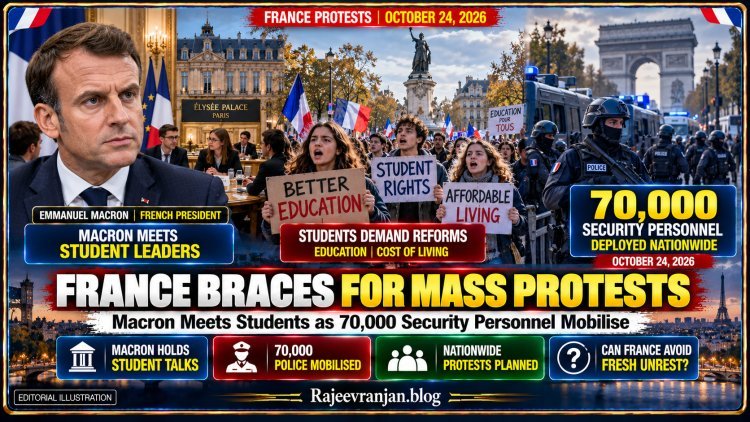
At the Élysée Palace, President Emmanuel Macron has been trying a different approach: listening directly to students whose protests helped ignite the crisis.
But Friday's meeting produced no immediate breakthrough.
Student representatives emerged from their discussions saying that while the president had listened to their grievances, they were still waiting for concrete government commitments.
Meanwhile, French authorities announced that approximately 70,000 police officers and gendarmes would be deployed nationwide on Saturday, October 24, following serious violence during demonstrations a week earlier.
The deployment is roughly 10,000 personnel larger than the security operation mounted on October 17.
The government says the measures are intended to protect demonstrators, residents, businesses and public infrastructure.
Protest organisers and civil-liberties advocates, however, have raised concerns about restrictions on demonstrations and the possibility of confrontations between police and participants.
The crisis has become a major political challenge for Macron, whose presidency is approaching its final months.
For the French government, the immediate priority is preventing renewed violence.
For students and other demonstrators, the central demand remains unchanged: meaningful action on the problems that brought them into the streets.
Macron Meets Student Leaders for the First Time
On Friday, October 23, Macron held talks with representatives of French secondary-school students at the Élysée Palace.
The meeting lasted approximately two and a half hours.
It marked the president's first direct meeting with representatives of the student movement that has been protesting since September.
Around 20 representatives attended the discussions.
The students raised concerns about deteriorating school infrastructure, insufficient educational resources and France's university admissions system.
Among their principal demands is a major overhaul of Parcoursup, the national platform used by students applying for higher education.
According to reporting by AFP and French media, Macron acknowledged the need to reconsider the system.
His office indicated that the government would present commitments following further talks with education stakeholders.
However, the students remained cautious.
Student Representatives Say Talks Are Not Enough
Nathanael Combary, president of the student organisation High School Renewal, said Macron had listened to their concerns.
But he made clear that the discussions had not yet produced the results students were seeking.
Student groups urged their supporters to continue mobilising until the government announced credible measures.
The statement highlights a significant problem facing the French government.
Opening negotiations may reduce tensions, but dialogue alone is unlikely to satisfy demonstrators who believe previous promises have failed to address conditions in schools.
Prime Minister Sébastien Lecornu is expected to meet representatives of students, teachers and other stakeholders on Monday, October 26.
Those discussions could become an important test of whether the government can translate political engagement into practical reforms.
Why Are Students Protesting in France?
The movement began with complaints about France's education system.
Students initially organised demonstrations over inadequate teaching resources and deteriorating school conditions.
Their concerns included classroom overcrowding, teacher shortages, ageing school buildings and the procedures used to determine university admissions.
As demonstrations spread, the movement began attracting university students, trade unions and other groups.
The protests gradually became part of a wider expression of frustration over living costs and public services.
1. Poor School Conditions
Student organisations argue that some schools lack the resources needed to provide adequate learning environments.
They have demanded greater investment in buildings, teaching staff and educational equipment.
2. University Admission Reforms
France's Parcoursup system has become a particular target of criticism.
Student representatives want changes to how applicants are evaluated and assigned to higher-education institutions.
3. Rising Cost of Living
France has experienced public anger over household expenses, including food, transport, housing and energy.
These economic concerns have helped expand the protests beyond students.
4. Concerns About Police Conduct
Some students and civil-rights organisations have questioned the government's handling of demonstrations.
Earlier incidents involving arrests and police intervention have intensified criticism of the authorities.
5. Broader Dissatisfaction With Public Services
The movement has also become a platform for concerns about the quality and accessibility of public services.
The government has acknowledged that some student grievances are legitimate, while rejecting violence and destruction associated with certain demonstrations.
3. France Protest Crisis: Key Developments
| Date | Major Development |
|---|---|
| September 2026 | Student demonstrations begin over education-related grievances. |
| October 6 | Large nationwide student demonstrations take place. |
| October 17 | Protests expand amid wider anger over living costs; serious unrest occurs alongside demonstrations. |
| October 20 | Government announces stronger security measures for upcoming protests. |
| October 22 | Macron and senior officials review preparations for renewed demonstrations. |
| October 23 | Macron meets student representatives at the Élysée Palace. |
| October 23 | Interior Minister Laurent Nuñez confirms a deployment of approximately 70,000 security personnel. |
| October 24 | Nationwide demonstrations scheduled under heightened security. |
| October 26 | Prime Minister Lecornu expected to hold further discussions with education stakeholders. |
Important: As of the morning of October 24, the outcome of Saturday's demonstrations cannot be reported as a completed event.
4. Why France Is Deploying 70,000 Security Personnel
The extraordinary security arrangements follow serious unrest on October 17.
Last Saturday's demonstrations attracted large crowds across France.
While many participants protested peacefully, violence erupted in several cities.
Authorities reported vandalism, looting, fires and confrontations with police.
The unrest affected Paris, Marseille, Lyon and other urban centres.
Some businesses were damaged, and the government faced criticism over its handling of the disturbances.
French officials subsequently acknowledged weaknesses in their response.
The government now wants to prevent similar incidents.
Interior Minister Issues Warning
Interior Minister Laurent Nuñez confirmed the deployment of approximately 70,000 personnel nationwide.
Authorities say they have identified social-media messages encouraging violence, attacks on public buildings and looting.
Nuñez attributed some of those calls to radical left-wing groups.
These are government allegations concerning particular groups and should not be applied to the wider protest movement.
The security operation is expected to include specialist police units and additional surveillance resources.
Authorities have also prepared equipment such as water cannons, armoured vehicles and helicopters.
The government argues that these measures are necessary to prevent violence while allowing lawful demonstrations.
5. Paris, Lyon and Marseille Prepare for Disruptions
Security restrictions differ between cities.
In Paris, authorities have limited the permitted protest route to an area between Bastille and Nation.
Other locations face tighter restrictions.
Certain central areas of Lyon have been placed off-limits to demonstrators.
Additional restrictions have been announced in cities including Nice and Montpellier.
Police are also reviewing security around government buildings, commercial districts and transportation networks.
Major Paris Museums Close
The security situation has affected tourism and cultural events.
Major Paris institutions, including the Louvre and Musée d'Orsay, announced closures related to the demonstrations.
The Picasso Museum and Grand Palais were also among the institutions affected.
Art Basel Paris cancelled its weekend programme.
The decisions illustrate how the crisis has begun affecting industries beyond education and public administration.
Tourism, retail and hospitality businesses may experience disruption as visitors reconsider plans and authorities restrict access to some locations.
However, the eventual financial impact will depend on how events unfold and how quickly normal operations resume.
6. A Second Flashpoint: Marine Le Pen's Party Congress
Saturday's demonstrations are not limited to education and living costs.
Another major gathering is expected in Orléans, where Marine Le Pen's National Rally party is holding its congress.
Opponents of the party have organised a counter-demonstration.
Authorities expect approximately 20,000 to 30,000 participants at the protest against the far right.
The prospect of opposing political groups gathering in the same city has raised additional security concerns.
Officials have imposed restrictions intended to reduce the risk of confrontations.
The political dimension is significant because France is approaching its 2027 presidential election.
Macron is constitutionally barred from seeking a third consecutive presidential term.
The protests are therefore unfolding during a sensitive period of political transition.
Although the crisis may influence public attitudes, it would be premature to conclude how it will affect the outcome of the next presidential election.
7. The Bigger Question: Can Macron Restore Public Trust?
The French president faces two challenges that require different responses.
The first concerns public order.
The government must protect people and property while preserving the right to peaceful protest.
The second concerns the issues behind the demonstrations.
Students want improvements in education.
Workers and households are concerned about rising expenses.
Other groups are demanding changes to public services and government policies.
A larger police deployment may reduce the risk of violence, but it cannot independently resolve these underlying grievances.
Similarly, negotiations may create an opportunity for compromise, but their effectiveness will depend on what the government actually delivers.
Why Monday's Meeting Matters
The planned October 26 discussions offer the government another opportunity to address student demands.
Possible areas of discussion include school funding, infrastructure, teacher availability and Parcoursup reforms.
Student organisations will be looking for specific commitments rather than general statements.
The government will also need to explain how proposed measures would be funded and implemented.
The outcome could influence whether demonstrations continue or whether negotiations begin to reduce tensions.
8. What Do the Protests Mean for France's Economy?
France is one of Europe's largest economies and a major destination for international tourism.
Prolonged demonstrations and business disruptions can affect economic activity.
Retail and Hospitality
Shop closures, damaged property and reduced foot traffic can affect businesses in protest areas.
Tourism
Restrictions around cultural attractions may disrupt visitors and travel arrangements.
Transportation
Road closures and security measures can create delays for commuters and travellers.
Public Finances
Large security deployments and infrastructure repairs create additional government expenses.
Consumer Confidence
Political uncertainty and concerns about unrest may influence household spending and business decisions.
However, the national economic impact cannot yet be quantified reliably.
It would be inaccurate to assume that the protests have caused a specific decline in French economic growth without supporting data.
9. What Happens Next?
Several developments will determine whether the situation begins to stabilise.
Saturday's demonstrations: Authorities will assess turnout, public safety and whether protests remain peaceful.
Police response: The government will face scrutiny over the proportionality and effectiveness of security measures.
Monday's negotiations: Student representatives will look for concrete proposals from Prime Minister Lecornu.
Business disruptions: Authorities and companies will assess damage, closures and the speed of reopening.
Political reactions: Opposition parties and civil-society organisations are expected to continue debating the government's response.
For Macron, the immediate challenge is preventing another weekend of serious unrest.
For the protest movement, the focus is on securing meaningful policy changes.
10. Conclusion: France's Crisis Is About More Than Street Protests
France's latest wave of demonstrations has developed into a major challenge involving education, economic pressure and public confidence in government.
President Emmanuel Macron's meeting with student representatives shows that the administration recognises the need for dialogue.
But students have made clear that they want measurable results.
At the same time, the deployment of 70,000 security personnel demonstrates how seriously the government is treating the possibility of renewed violence.
France now faces the difficult task of protecting public order while respecting the rights of peaceful demonstrators.
The real test for Macron will not simply be whether France avoids another weekend of violence. It will be whether the government can address the grievances that brought thousands of people onto the streets in the first place.