


Chhath Puja 2026: Patna Tightens Ghat Security, Barricading and Crowd-Control Arrangements Ahead of Festival
Patna strengthens Chhath Puja 2026 ghat security with barricading, rescue teams and crowd-control plans. Check safety updates and festival dates.
 Rajeev

Chhath Puja 2026: Patna Tightens Ghat Security, Barricading and Crowd-Control Arrangements Ahead of Festival
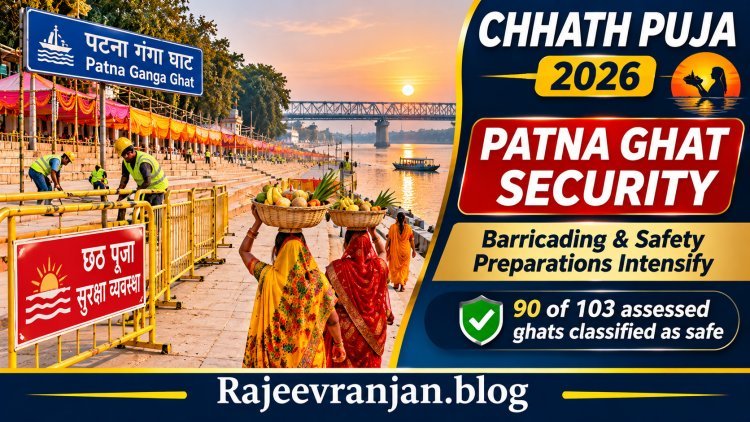
With Chhath Puja beginning on November 13, Patna authorities are strengthening safety arrangements at Ganga ghats, including barricading near dangerous stretches, rescue-team deployment, lighting and crowd management. The Bihar government says 90 of 103 assessed riverfront ghats have been classified as safe, while preparations continue for one of the state's most important religious festivals.
PATNA | November 12, 2026
As Bihar prepares for Chhath Puja, the Ganga riverfront in Patna is undergoing an extensive round of cleaning, repairs and safety preparations.
The challenge for local authorities is substantial.
Thousands of families traditionally gather along the river to offer prayers to the setting and rising sun. During the principal rituals, ghats must accommodate worshippers carrying offerings, elderly devotees, children and other visitors, often within a relatively short period.
This year, the administration is placing particular emphasis on preventing overcrowding, restricting access to dangerous sections of the river and ensuring that devotees can reach worship locations safely.
According to an official Bihar government statement issued on November 10, Chief Minister Samrat Choudhary inspected several Ganga ghats for a second time and reviewed ongoing security and sanitation arrangements.
The government reported that 90 of the 103 ghats covered by its assessment were considered safe, while 13 were still being identified or assessed.
Officials have been instructed to strengthen barricading near the water, improve access routes and provide continuous information to devotees through public announcements.
The preparations come ahead of Sandhya Arghya on November 15 and Usha Arghya on November 16, the two principal riverfront observances of Chhath Puja.
Patna Chhath Ghat Security: What Has the Government Announced?
The November 10 inspection was part of a broader effort to review conditions at Patna's Ganga ghats before the festival.
The chief minister travelled by steamer along sections of the riverfront, inspecting locations including Nasriganj Ghat, Collectorate Ghat, Gandhi Ghat, Pahalwan Ghat, Gulbi Ghat, Chaudhary Tola Ghat, Pathri Ghat and areas between Gaighat and Mahavir Ghat.
Officials were directed to complete remaining arrangements so that devotees could perform their rituals without unnecessary difficulty.
The government's instructions focused on three immediate concerns: river safety, crowd movement and cleanliness.
Particular attention was given to the Ganga's water level and current, which can affect the safety of different sections of the riverbank.
The chief minister also instructed authorities to install strong barricades along approach roads and near the riverfront to improve pedestrian movement.
Public-address systems are expected to play an important role in communicating safety instructions and other information during the celebrations.
The official statement did not establish that every individual work had already been completed as of November 12.
90 Ghats Classified as Safe: What About the Remaining 13?
The latest official assessment provides an important indication of the preparations.
On November 10, the Bihar Chief Minister's Office reported that 90 of 103 ghats were considered safe.
The remaining 13 were still undergoing identification or assessment.
This represents an improvement from an earlier government statement dated November 5.
At that time, officials had reported 91 safe ghats, five dangerous locations and seven sites where work was continuing.
The figures should not be interpreted as a simple comparison of completed construction work. They reflect assessments reported on different dates, and the government did not publish a complete site-by-site reconciliation in the statements reviewed.
For devotees, the most important issue is the latest safety classification of the particular ghat they intend to visit.
A ghat that was traditionally popular or accessible in previous years should not automatically be assumed safe this year.
Changing river conditions, damaged approaches and temporary restrictions may affect public access.
Families should follow local administration notices and avoid entering any ghat marked dangerous or restricted.
Why Barricading Is a Major Priority This Year
Barricading is among the most important physical safety measures being introduced at Patna's ghats.
Unlike ordinary riverside visits, Chhath Puja involves large groups entering or standing near the water at nearly the same time.
That creates particular risks when river currents, uneven steps or sudden changes in depth are present.
The authorities have directed officials to install strong barricading at hazardous locations.
At some ghats, dangerous stretches are to be identified using warning boards and red markings.
The barriers are intended to discourage people from entering unsafe areas and help maintain boundaries between accessible worship spaces and potentially dangerous sections.
The arrangements also extend to pathways and roads connecting the ghats with surrounding neighbourhoods.
However, barricading does not eliminate every water-related risk.
Devotees should avoid crossing marked safety boundaries or assuming that an unmarked stretch of river is suitable for entering.
The government's instructions make clear that river conditions must be considered when preparing each site.
Hundreds of Ghats Across Patna District Under Preparation
The preparations extend beyond the city's principal Ganga ghats.
According to district-level reporting published on November 3 and 4, authorities were preparing facilities across 458 Chhath ghats in Patna district.
These include worship locations outside the main municipal riverfront.
The district administration has instructed officials to arrange access roads, lighting, sanitation, changing rooms and security facilities.
Major locations are also being considered for CCTV monitoring, watchtowers and public-address systems.
District Magistrate Kundan Kumar directed officials to ensure that dangerous ghats are identified and barricaded.
The administration has also been developing alternative worship locations where existing riverfront access is unsuitable.
Such arrangements are particularly important for families unable to travel to the Ganga.
The reported districtwide figures should be distinguished from the 103-ghat assessment discussed by the chief minister.
They represent different administrative and operational categories rather than competing totals.
Rescue Teams, Divers and Medical Services on Alert
Water safety is another major component of this year's preparations.
On November 9, Bihar's Disaster Management Department issued directions requiring districts to strengthen emergency arrangements during Chhath Puja.
According to PTI, the department instructed authorities to station trained divers, swimmers, motorboats and life-saving equipment at river ghats.
Medical teams, ambulances and Quick Medical Response Teams are also to remain prepared.
The department called for round-the-clock control-room operations and regular public announcements.
In Patna, reports have outlined plans to deploy National Disaster Response Force teams along major stretches of the Ganga, including areas between Danapur and Kangan Ghat.
State Disaster Response Force teams are also involved in inspecting and reviewing safety arrangements.
The purpose is to ensure that trained personnel and equipment are available if an emergency occurs.
However, the existence of a deployment plan should not be treated as confirmation that every rescue team is already stationed at every designated location.
Devotees should follow instructions from personnel present at their chosen ghat.
Private Boats and Firecrackers Restricted Near Chhath Ghats
The Bihar government has announced additional precautions concerning activities near worship locations.
According to the Disaster Management Department's November 9 directions, private boat operations are prohibited during the Chhath observance period.
The state has also directed authorities to enforce restrictions on firecrackers near ghats.
These measures are intended to reduce avoidable hazards in crowded riverside areas.
Unregulated boat movement can create risks when large numbers of people are standing in or near the water.
Similarly, firecrackers can cause injuries, panic and difficulties for crowd management.
Devotees should not use private boats for access to restricted riverfront locations.
They should also avoid fireworks and follow local police instructions regarding permissible activities.
The restrictions are part of wider safety arrangements rather than changes to the religious observance itself.
Flood Damage, Silt and Receding Water Create Additional Challenges
Security planning is only one part of the work.
Patna's riverfront has also experienced problems associated with silt accumulation and changing Ganga water levels.
Reporting by The Times of India on October 29 described heavy deposits of silt following the monsoon, damaged steps and partially submerged structures at some ghats.
Receding water levels can also increase the distance between established access points and the river.
This presents difficulties for devotees carrying large baskets of offerings, particularly elderly worshippers and people with limited mobility.
Patna Municipal Corporation has directed workers to remove obstructions, repair approach roads and improve sanitation.
Municipal Commissioner Yashpal Meena inspected 24 ghats on November 8 and instructed officials to remove temporary encroachments.
He also called for repairs to toilets and changing rooms and replacement of outdated signboards.
These measures are intended to improve movement and reduce crowding at the riverfront.
Traffic Management and Lighting: What Devotees Should Expect
Large crowds travelling to riverside ghats can place considerable pressure on Patna's road network.
For that reason, officials have been directed to prepare traffic-management plans and improve pedestrian access.
Senior Superintendent of Police Kartikeya K. Sharma has emphasized coordination between police stations and local authorities.
The arrangements include identifying parking areas, reviewing approach roads and preparing for increased movement around major worship locations.
Adequate lighting is another priority.
Because devotees gather before sunrise for Usha Arghya, poorly illuminated roads and steps can present particular hazards.
The administration has directed electricity officials to inspect wiring and temporary electrical connections used during festival preparations.
Such inspections are intended to reduce the risk of electrical accidents in crowded and potentially damp environments.
Specific road closures and parking restrictions may vary by location.
Devotees should check the latest traffic advisories before travelling rather than relying on arrangements from previous years.
Chhath Puja 2026 Dates and Arghya Timings in Patna
The four-day Chhath festival begins on November 13 and concludes on November 16.
According to Drik Panchang's location-specific calendar for Patna, the observances are scheduled as follows:
| Date | Day | Ritual |
|---|---|---|
| November 13, 2026 | Friday | Nahay Khay |
| November 14, 2026 | Saturday | Kharna |
| November 15, 2026 | Sunday | Sandhya Arghya |
| November 16, 2026 | Monday | Usha Arghya |
Patna sunset on November 15: Approximately 5:01 PM IST.
Patna sunrise on November 16: Approximately 6:07 AM IST.
These are local astronomical timings. Families should follow their customary ritual arrangements and any instructions issued by the local administration.
What Families Should Check Before Visiting a Ghat
For families planning to attend the celebrations, a small amount of preparation can make the experience safer.
Before leaving home, confirm that the intended ghat is officially accessible and not marked dangerous.
Choose a route approved for pedestrian movement and allow additional travel time because of possible traffic restrictions.
People accompanying elderly relatives or children should consider the walking distance, availability of lighting and condition of the approach road.
At the riverbank, remain within marked worship areas and avoid stepping beyond barricades.
Do not allow children to enter the water unattended.
Visitors should also follow announcements from police and local authorities, especially if a route becomes crowded or access is temporarily restricted.
In an emergency, people should seek assistance from the nearest police officer, medical team or designated control room.
The Bihar Police control-room numbers published for the festival include 0612-2294318, 0612-2294319 and 0612-2294323. These should be treated as published state-level assistance contacts, not substitutes for local emergency instructions.
The Final Challenge Before Chhath Puja
With Chhath Puja beginning on November 13, Patna's preparations have entered their final stage.
The administration has identified river safety, barricading, sanitation, lighting and traffic movement as priorities.
The latest official assessment indicates that 90 of 103 reviewed Ganga ghats have been classified as safe, while additional assessment and preparation work continues.
The larger challenge is ensuring that arrangements function effectively when devotees begin gathering in substantial numbers.
For residents, the safest approach is to follow the latest official guidance and use designated worship locations.
Chhath is deeply connected to Bihar's cultural and spiritual identity. Families return to their hometowns, communities prepare offerings together, and the riverfront becomes a place of shared devotion.
The success of this year's preparations will ultimately be measured not only by the number of barricades, lights or temporary facilities installed, but by whether devotees can perform their rituals safely and without unnecessary difficulty.
As Patna prepares to welcome Chhath Puja 2026, the priority remains clear: preserving the festival's traditions while protecting the people who come together to celebrate them.