


Iran War Latest: Tehran Warns of Wider Retaliation as Israel Prepares for Possible Strikes; 6 Killed in Gaza Hospital Attack
Iran warns of wider retaliation as Israel reportedly prepares possible strikes. Six people are killed at a Gaza hospital amid growing Middle East tensions.
 Rajeev
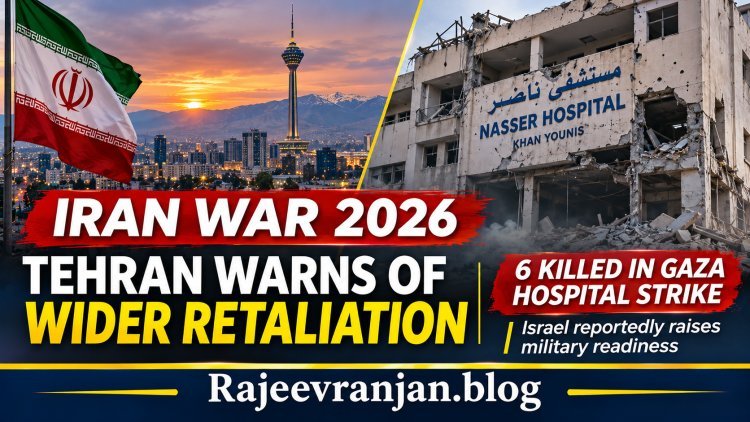

Iran War Latest: Tehran Warns of Wider Retaliation as Israel Prepares for Possible Strikes; 6 Killed in Gaza Hospital Attack
Iran has threatened to expand its military retaliation beyond the Middle East if the United States launches renewed attacks, while Israeli media report preparations for possible strikes against Tehran. Meanwhile, an Israeli airstrike on Nasser Hospital in southern Gaza has killed six people, including a doctor and a child, adding to concerns about civilian safety and regional escalation.
TEHRAN / JERUSALEM / GAZA | November 12, 2026
The Middle East faces renewed fears of military escalation after Iran warned that American bases extending into Europe could become targets if the United States launches fresh attacks against the country.
The warning comes as Israeli media report that Prime Minister Benjamin Netanyahu's security cabinet has instructed the military to increase its readiness for possible operations against Iran.
At the same time, the humanitarian situation in Gaza has deteriorated following a deadly Israeli strike on Nasser Hospital in Khan Younis.
According to Gaza's Health Ministry, six people were killed in the hospital attack, including a surgeon and a 13-year-old boy. The Associated Press reported that at least 28 others were wounded.
Israel said it had targeted a Hamas commander and other militants operating inside the hospital, but did not provide evidence supporting the claim in the reporting reviewed.
These developments have emerged despite diplomatic efforts aimed at preventing renewed large-scale fighting between Washington and Tehran.
The central concern is that military threats, disputed negotiations and continuing violence in Gaza could undermine attempts to establish a more stable regional security arrangement.
Iran Warns US Military Bases in Europe Could Become Targets
Iran's latest warning represents a significant escalation in its public military rhetoric.
Mohsen Rezaei, secretary of Iran's Supreme National Security Council, said Tehran would target military facilities involved in any renewed American offensive, regardless of their geographical location.
His warning specifically extended beyond the Middle East to military installations in Europe.
According to Anadolu Agency, Rezaei said that bases used to launch attacks against Iran would be considered potential targets for retaliation.
He reinforced the warning with a statement emphasizing that geographical distance would not guarantee protection.
The remarks followed similar comments from Kioumars Heydari, deputy chief of the Iranian Armed Forces' General Staff.
Heydari warned that countries allowing their territory to be used for attacks against Iran could face consequences.
These statements are conditional threats.
They do not establish that Iranian forces have launched strikes against European military installations.
However, the possibility of a confrontation involving facilities outside the Middle East introduces additional risks for countries hosting American military personnel and infrastructure.
Israel Reportedly Orders Military to Prepare for Possible Iran Strikes
The Iranian warnings followed reports that Israel had increased preparations for potential military operations against Tehran.
According to Israeli public broadcaster KAN, Netanyahu's security cabinet directed the military to strengthen its readiness for possible attacks.
The report did not establish that a final decision had been taken to launch an offensive.
Nor did it provide an independently verified timetable for military action.
Nevertheless, the reported preparations have intensified concerns that Israel could undertake operations capable of provoking another round of retaliation.
The development also comes during a politically sensitive period in Israel.
Netanyahu remains prime minister in a caretaker capacity while former military chief Gadi Eisenkot attempts to form a new government following the country's October election.
Eisenkot has warned against initiating military operations without an immediate threat while the government-formation process remains unresolved.
The disagreement illustrates how Israel's domestic political uncertainty intersects with major national-security decisions.
Military preparations are not the same as a confirmed attack order, but they can increase tensions when opposing forces interpret them as evidence of imminent action.
Iran's Revolutionary Guards Vow to Continue Missile Development
Iran has also reaffirmed its intention to continue developing ballistic-missile capabilities.
Ahmad Vahidi, commander-in-chief of the Islamic Revolutionary Guard Corps, said Iran's missile programme would not be stopped by international threats or sanctions.
His comments were reported by Iranian state media and subsequently carried by Iran International on November 12.
Vahidi made the remarks while commemorating Hassan Tehrani Moghaddam, a prominent figure in Iran's missile-development programme who died in an explosion at a military facility in November 2011.
The statement reinforces Tehran's position that military capabilities remain essential to its national defence.
From Iran's perspective, missile development provides a means of deterring attacks.
Israel and the United States, however, regard Iran's missile capabilities as a significant security concern.
The disagreement is particularly important because Iran's missile programme is separate from, though closely connected to, negotiations concerning its nuclear activities.
A diplomatic settlement addressing nuclear restrictions would not necessarily resolve disputes over conventional missiles and regional security.
Israeli Strike on Nasser Hospital Kills Six in Southern Gaza
While tensions between Iran and Israel intensified, a separate Israeli military operation caused significant casualties at a major hospital in Gaza.
An Israeli airstrike hit Nasser Hospital in Khan Younis shortly after midnight on Thursday, November 12.
According to the Associated Press, the attack struck the hospital's surgical wing, damaging operating rooms and medical facilities.
Gaza's Health Ministry reported six fatalities.
Among those killed were general surgeon Dr. Rizk Abu Shaira and a 13-year-old patient.
At least 28 people were injured.
The strike damaged parts of the hospital's second floor, leaving debris scattered across treatment areas.
Medical personnel reported significant disruption to surgical services, radiology and laboratory operations.
Nasser Hospital is among the major medical institutions still functioning in Gaza, where healthcare infrastructure has suffered extensive damage during years of conflict.
The loss of medical personnel and specialized facilities creates consequences that extend beyond the immediate casualty count.
Patients requiring surgery, diagnostic testing and follow-up care may face further difficulties accessing treatment.
What Has Israel Said About the Hospital Strike?
The Israeli military acknowledged carrying out the attack.
It said the operation targeted a senior Hamas commander and other militants allegedly operating within the hospital complex.
Israel has repeatedly accused Hamas and other armed groups of using medical facilities for military purposes.
Hamas rejects such allegations concerning the latest attack.
The Associated Press reported that the Israeli military did not provide evidence supporting its specific claims about the intended target.
The commander named by Israel was not among those reported killed.
Hospital officials said the strike occurred without advance warning.
The competing statements leave important questions unresolved concerning the intended target, the information used to authorize the operation and the precautions taken to protect civilians.
Under international humanitarian law, medical facilities enjoy special protection.
That protection is not unlimited if facilities are used to commit acts harmful to the enemy, but any military operation remains subject to applicable legal requirements, including precautions to protect civilians and proportionality.
A definitive assessment of the legality of this particular strike would require evidence beyond the initial public statements.
Gaza's Humanitarian Crisis Deepens as Heavy Rains Destroy Shelters
The hospital strike occurred amid a worsening humanitarian emergency.
Heavy rainfall beginning on November 6 caused extensive flooding across Gaza, damaging temporary shelters and forcing displaced families to seek safer locations.
According to the United Nations Office for the Coordination of Humanitarian Affairs, more than 26,000 households had requested assistance after rain damaged their shelters or belongings.
Preliminary assessments indicated that more than 6,000 family shelters had been destroyed and another 17,400 damaged.
The United Nations also reported that approximately 1.4 million people in Gaza were living in tents or makeshift accommodation.
Many of these shelters provide limited protection against heavy rain, wind and falling temperatures.
UNICEF warned that nearly one million displaced people were living in flood-exposed areas, including hundreds of thousands facing particularly serious risks.
Humanitarian organizations have called for additional shelter materials, drainage equipment and essential supplies.
The combination of continued military operations, damaged hospitals and worsening weather is placing further pressure on civilians who already face severe displacement and limited access to basic services.
Why US-Iran Peace Talks Remain Uncertain
The heightened military rhetoric comes only days after President Donald Trump suggested that large-scale American operations against Iran might no longer be necessary.
Following discussions involving Qatar, Trump expressed confidence that Washington had achieved significant military objectives.
However, Iranian officials have continued to challenge American descriptions of diplomatic progress.
Tehran insists that sanctions relief, maritime restrictions and other conditions must be addressed.
The United States continues to demand assurances concerning Iran's nuclear programme.
The dispute also involves Iran's stockpile of highly enriched uranium.
Recent reporting indicates that Tehran rejected a proposal involving the transfer of uranium enriched to 60 percent purity to another country.
Meanwhile, American military forces continue enforcing restrictions affecting Iranian maritime trade.
These disagreements reveal why diplomatic communication has not yet produced a comprehensive settlement.
Washington wants security assurances before offering major concessions.
Tehran wants meaningful relief from economic and military pressure before accepting broader commitments.
Neither government has publicly confirmed a final agreement resolving those differences.
Strait of Hormuz Tensions Raise Concerns for Global Energy Markets
The Strait of Hormuz remains a major point of tension.
The narrow waterway connects the Persian Gulf with the Gulf of Oman and is crucial for international oil and liquefied natural gas transportation.
Disruption to shipping can affect energy prices, insurance costs and supply-chain planning.
According to Al Jazeera's November 12 reporting, oil prices rose on Wednesday after Iran rejected an American proposal concerning its enriched uranium stockpile.
Brent crude futures settled at $92.76 per barrel, while US West Texas Intermediate crude closed at $86.53.
These are historical settlement figures for the reported trading session, not live quotations.
The price movement illustrates how markets react to uncertainty surrounding regional diplomacy and security.
For India, a major energy importer, continued tension around the strait creates potential risks involving import costs and shipping arrangements.
However, the extent of any impact on Indian fuel prices would depend on broader market conditions and government pricing decisions.
What Could Happen Next?
Three developments will be particularly important in determining whether the confrontation escalates.
The first is whether Israel moves beyond reported military preparations and launches new operations against Iran.
The second is whether Tehran acts on its warnings if American or Israeli attacks occur.
The third is whether ongoing diplomatic efforts can produce a negotiated framework addressing sanctions, nuclear restrictions and maritime security.
Meanwhile, Gaza's humanitarian situation will require continued attention regardless of developments involving Iran.
The Nasser Hospital strike has raised further questions about civilian protection, while flooding has intensified the difficulties facing displaced families.
International pressure for restraint may increase, but diplomatic statements alone cannot guarantee that military operations will stop.
Middle East Conflict Enters Another Dangerous Phase
The events of November 12 underline the fragile security environment across the Middle East.
Iran has warned that retaliation against renewed American attacks could extend well beyond the region.
Israeli media report increased preparations for possible operations against Tehran.
At the same time, a confirmed Israeli strike on Nasser Hospital has killed six Palestinians and damaged vital medical facilities.
The developments demonstrate how military escalation and humanitarian suffering can unfold simultaneously across different parts of the region.
For governments seeking a diplomatic settlement, the challenge is increasingly urgent.
As of November 12, 2026, no comprehensive agreement ending the US-Iran conflict has been confirmed, and the reported Israeli preparations have not been established as a new offensive.
The immediate priority remains preventing further escalation while protecting civilians and maintaining access to essential humanitarian assistance.