



Japan Earthquake: Magnitude 5.7 Quake Hits Shizuoka, At Least 27 Injured as Strong Tremors Shake Central Japan
A magnitude 5.7 earthquake struck Japan's Shizuoka region on November 8, 2026. At least 27 injuries were reported, with train delays but no tsunami threat.
 Rajeev
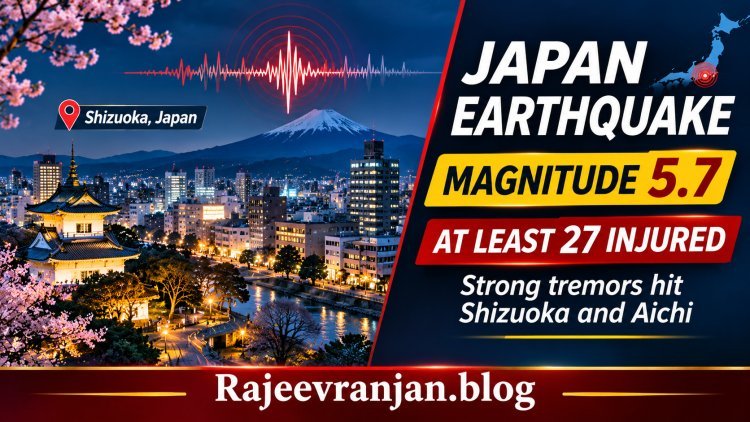

Japan Earthquake: Magnitude 5.7 Quake Hits Shizuoka, At Least 27 Injured as Strong Tremors Shake Central Japan
A powerful nighttime earthquake struck western Shizuoka Prefecture on November 8, 2026, injuring residents across central Japan and disrupting railway operations. Authorities have ruled out a tsunami threat but warned that further strong shaking remains possible over the coming days.
TOKYO, JAPAN | November 8, 2026
A magnitude 5.7 earthquake struck central Japan early Sunday, November 8, shaking several prefectures, injuring residents and prompting emergency safety checks across the affected region.
The earthquake occurred at approximately 1:04 AM Japan Standard Time, with its epicentre in western Shizuoka Prefecture.
According to the Japan Meteorological Agency (JMA), the earthquake originated at a depth of approximately 41 kilometres.
The strongest shaking was recorded in Chita City, Aichi Prefecture, where seismic intensity reached upper 5 on Japan's seven-level intensity scale.
Strong tremors were also recorded in Shizuoka, Nagano, Gifu and other parts of central Japan.
By Sunday morning, Japanese media had reported at least 24 injuries in Aichi Prefecture and three minor injuries in Shizuoka Prefecture.
No tsunami threat was associated with the earthquake.
However, Japanese authorities warned residents to remain alert because additional strong earthquakes could occur in the affected region during the following week.
The earthquake also caused delays on portions of the Tokaido Shinkansen high-speed railway, an important transport connection between Tokyo and western Japan.
The developments underline the challenges faced by one of the world's most earthquake-prone countries, where even moderate-magnitude earthquakes can cause significant local shaking and disruption.
Japan Earthquake November 8: What Happened?
The earthquake struck shortly after 1 AM local time, when many residents were asleep.
The Japan Meteorological Agency initially estimated the earthquake's depth at approximately 40 kilometres before revising the provisional figure to 41 kilometres.
Its magnitude remained provisionally estimated at 5.7.
The earthquake occurred within the Philippine Sea Plate, according to the JMA's preliminary analysis.
The agency identified the strongest observed seismic intensity as upper 5 in Chita City, Aichi Prefecture.
Although the epicentre was located in western Shizuoka, the highest recorded intensity occurred outside the prefecture.
That distinction is important because earthquake magnitude and the strength of shaking at individual locations are not the same measurement.
The JMA issued an earthquake early warning, while seismic monitoring stations recorded shaking across an extensive area of central and western Japan.
Where Were the Strongest Earthquake Tremors Recorded?
The earthquake was felt across a broad geographical area.
According to the Japan Meteorological Agency and Japanese earthquake-monitoring services, the strongest shaking was concentrated in parts of Aichi, Shizuoka, Gifu and Nagano prefectures.
Areas Reporting Strong Shaking
| Location | Maximum Recorded Seismic Intensity |
|---|---|
| Chita City, Aichi | Upper 5 |
| Hamamatsu, Hamana Ward, Shizuoka | Lower 5 |
| Seto City, Aichi | Lower 5 |
| Handa City, Aichi | Lower 5 |
| Toyota City, Aichi | Lower 5 |
| Kariya City, Aichi | Lower 5 |
| Ena City, Gifu | Lower 5 |
| Urugi Village, Nagano | Lower 5 |
| Parts of Nagoya, Aichi | 4 |
| Iwata City, Shizuoka | 4 |
| Kakegawa City, Shizuoka | 4 |
Source: Japan Meteorological Agency seismic observations, November 8, 2026.
The shaking was not confined to areas immediately surrounding the epicentre.
Lower-intensity tremors were recorded across a much wider region, extending into parts of the Kanto and Kansai areas.
This broad distribution reflects how seismic waves travel through the Earth's crust.
However, the intensity experienced at a particular location depends on factors including distance from the source, underground geological conditions and the characteristics of the earthquake.
At Least 27 Injuries Reported Across Aichi and Shizuoka
The earthquake resulted in injuries in several communities, according to local Japanese reporting.
Television Asahi reported at 6:29 AM Japan time that at least 24 people had been injured in Aichi Prefecture.
Among them was a woman in her 50s in Tokoname City who reportedly fractured her right ankle after falling while evacuating.
In Shizuoka Prefecture, local broadcaster SBS reported three minor injuries.
One incident involved a woman in her 80s in Hamamatsu who fell at home after being startled by the earthquake and injured her lower back.
Other injuries were reported in Kakegawa and Mori.
Earlier Japanese reports described a woman in Kakegawa who injured her shoulder and an elderly woman in Mori who fell from her bed.
Together, the separately reported Aichi and Shizuoka figures indicate at least 27 injuries as of the morning reports reviewed.
This is a provisional total, not a final official nationwide casualty count.
The actual number may change as authorities receive additional reports or reconcile information from hospitals and local governments.
No Tsunami Threat Following the Earthquake
One of the most important announcements came from the Japan Meteorological Agency, which confirmed that the earthquake did not pose a tsunami threat.
No tsunami warning or advisory was issued for this event.
The earthquake originated underground in western Shizuoka rather than beneath the ocean.
The JMA's assessment provided reassurance to coastal communities concerned about possible tsunami-related consequences.
However, the absence of a tsunami threat does not mean the earthquake was harmless.
Strong ground shaking can cause injuries, falling objects, structural damage and transport disruption even when no tsunami develops.
Residents in affected areas were therefore advised to continue monitoring official safety information.
High-Speed Train Services Disrupted After Tremors
The earthquake also affected railway operations.
According to local broadcaster SBS, the Tokaido Shinkansen experienced delays from the start of Sunday morning services.
JR Central reduced train speeds as a precaution on sections between Shizuoka and Gifu-Hashima stations while safety checks and operational assessments were carried out.
The Tokaido Shinkansen is one of Japan's most important high-speed railway routes, connecting major cities including Tokyo, Nagoya, Kyoto and Osaka.
Even temporary speed restrictions can affect journey times across the wider network.
Separately, Japanese reporting indicated that the overnight Sunrise Seto and Sunrise Izumo sleeper services experienced an emergency stop following the earthquake.
The precise duration of all disruptions remained subject to railway operator updates.
There was no verified evidence in the reports reviewed of widespread or prolonged damage to the high-speed railway infrastructure.
Was Japan's Hamaoka Nuclear Power Plant Affected?
The earthquake also prompted attention to the Hamaoka Nuclear Power Plant in Shizuoka Prefecture.
The facility is located in Omaezaki and is operated by Chubu Electric Power.
According to Japanese television reporting, the operator found no earthquake-related abnormalities affecting Units 1 through 5.
This assessment was particularly relevant because the earthquake's epicentre was located within Shizuoka Prefecture.
Nuclear facilities in earthquake-prone regions are subject to specialized safety monitoring and emergency procedures.
However, the absence of reported abnormalities at Hamaoka should not be interpreted as a comprehensive assessment of every industrial facility in the affected region.
The available reporting specifically supports the statement that no earthquake-related problems were identified at the Hamaoka facility during the initial checks.
Why Did a Magnitude 5.7 Earthquake Cause Strong Shaking?
A magnitude 5.7 earthquake is substantially smaller than Japan's largest historical earthquakes.
Nevertheless, it can produce strong shaking in communities close to the source.
This is because magnitude measures the size of the earthquake at its source, while seismic intensity measures the shaking experienced at a particular location.
Japan uses the Shindo seismic intensity scale to describe the strength of ground movement.
The scale runs from 0 to 7, with several intermediate categories.
An intensity of upper 5 indicates shaking strong enough to make standing difficult for some people and cause unsecured objects or furniture to move or fall.
The actual effects depend on local conditions, building design and the vulnerability of surrounding infrastructure.
In the November 8 earthquake, Chita City in Aichi Prefecture experienced the highest recorded intensity even though the earthquake originated in Shizuoka.
This illustrates why residents should pay attention to local intensity measurements rather than judging an earthquake solely by its magnitude.
Japan Meteorological Agency Warns of Further Strong Earthquakes
The Japan Meteorological Agency issued an important warning following the earthquake.
It advised residents in strongly affected areas to remain alert for approximately one week because further earthquakes producing shaking of up to upper 5 intensity could occur.
The agency emphasized particular caution during the first two to three days.
This warning reflects patterns observed after previous significant earthquakes, when strong subsequent tremors have sometimes occurred.
It does not mean another earthquake of the same intensity is certain.
The JMA also warned that strong shaking can increase the danger of falling rocks and landslides, especially in vulnerable mountainous areas or locations affected by rain.
As of 2:35 AM on November 8, the agency had recorded one subsequent earthquake with a seismic intensity of at least 1.
Another earthquake, measuring magnitude 3.3, was subsequently recorded in eastern Aichi Prefecture at approximately 2:03 AM, with a maximum intensity of 2.
Is the Shizuoka Earthquake Connected to the Nankai Trough?
The earthquake's location is significant because western Shizuoka lies within a region associated with Japan's Nankai Trough earthquake hazard.
The Nankai Trough is a major tectonic boundary where the Philippine Sea Plate interacts with the overriding plate beneath southwestern Japan.
Large earthquakes have occurred along this boundary in the past.
However, scientists distinguish between earthquakes occurring within a tectonic plate and major earthquakes involving movement along a plate boundary.
The Japan Meteorological Agency reported that the November 8 earthquake occurred within the Philippine Sea Plate.
Although the earthquake took place inside the anticipated source region of a possible future Nankai Trough earthquake, the JMA stated that its magnitude did not indicate a particular change in the locking conditions along the plate boundary.
The agency said it would continue monitoring earthquake activity and crustal movements.
The November 8 earthquake should therefore not be described as proof that a major Nankai Trough earthquake is imminent.
What Should Residents Do After Strong Earthquake Tremors?
For people living in the affected areas, the immediate priority is to reduce the risk of injuries during further shaking.
Residents should check their surroundings for unstable furniture, damaged walls, broken glass and objects that could fall.
They should avoid entering visibly damaged buildings until the structures have been assessed as safe.
During renewed shaking, the safest immediate response indoors is generally to drop, cover and hold on, protecting the head and neck while staying away from windows.
People outdoors should move away from unstable walls, utility poles and other falling hazards when it is safe to do so.
Those in areas susceptible to landslides should pay particular attention to local evacuation notices, especially if rainfall follows the earthquake.
Travellers should check railway operator updates before beginning journeys.
Official information from the Japan Meteorological Agency and local disaster-management authorities should take priority over unverified social media reports.
Latest Japan Earthquake Update: What We Know
As of the morning of November 8, 2026, the Japan Meteorological Agency had confirmed a magnitude 5.7 earthquake centred in western Shizuoka Prefecture at a provisional depth of 41 kilometres.
The strongest shaking reached upper 5 in Chita City, Aichi Prefecture.
Japanese media reported at least 27 injuries across Aichi and Shizuoka, although the overall casualty assessment remained provisional.
There was no tsunami threat.
Some high-speed railway services experienced delays, while initial checks found no earthquake-related abnormalities at the Hamaoka Nuclear Power Plant.
The JMA has advised residents to remain cautious about further strong shaking during the coming week.
For Japan, the immediate challenge is to assess the damage, support injured residents and maintain public safety while seismic monitoring continues.
The earthquake is another reminder that preparedness, accurate information and timely emergency responses remain essential in a country where seismic activity is part of everyday life.