


Mega H-1B Relief: US Judge Strikes Down Trump’s $100,000 Visa Fee as ‘Unlawful Tax’
Massive win for tech professionals! A US Federal Judge has struck down the controversial $100,000 H-1B visa fee, calling it an unlawful tax. Read how it impacts tech aspirants.
 Rajeev

Major Setback for Trump: US Court Scraps Controversial $100,000 H-1B Visa Fee—What It Means for Aspiring Tech Professionals
In a massive development that has sent waves of relief across the global technology ecosystem, a United States federal court has officially struck down the Trump administration’s highly controversial $100,000 surcharge on new H-1B visas.
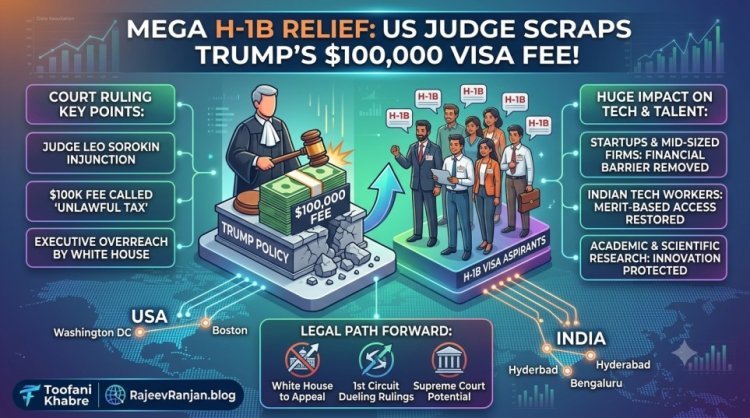
The landmark ruling, delivered on Monday by US District Judge Leo Sorokin in Boston, concludes that the executive branch drastically overstepped its legal boundaries. The court declared that the staggering fee effectively functioned as an unauthorized economic exclusion tax that Congress never sanctioned.
For tens of thousands of international professionals—particularly tech talent from India—this judicial intervention dismantles a massive financial barrier that threatened to reshape high-skilled immigration to America.
The Background: Trump’s Wall of "Economic Exclusion"
The legal battle traced back to September 19, 2025, when US President Donald Trump signed an aggressive executive proclamation targeting the H-1B visa framework. Promoted under the banner of protecting American domestic jobs and curbing alleged exploitation of the visa pipeline, the order hit prospective foreign workers with a staggering $100,000 fee for certain new petitions filed from abroad.
Prior to this executive shift, corporate employers traditionally navigated government filing fees ranging between $2,000 and $5,000 per specialized petition. By inflating the entry cost by thousands of percent, the policy was criticized by industry experts not as an immigration check, but as a deliberate economic blockade.
The immediate impact was devastatingly effective for immigration restrictionists. Data surfaced in court filings revealed that the US Citizenship and Immigration Services (USCIS) had processed a mere 85 payments of the $100,000 fee through mid-February—demonstrating that small businesses, startups, and universities had simply been priced out of the global market.
The Judgment: Executive Discretion vs. Congressional Power
A coalition of 20 Democratic state attorneys general led the multi-state legal charge against the enforcement. They successfully argued that the administration violated the Administrative Procedure Act and bypassed the legislative powers of Congress.
In his decisive summary judgment, Judge Leo Sorokin systematically pulled apart the administration's legal defenses:
“The substance and application of the $100,000 payment reveal that it is a tax, regardless of what the payment is called,” Sorokin affirmed.
The court reiterated that under the US Constitution, the power to levy taxes resides exclusively with the legislative branch (Congress). By unilaterally instituting a structural monetary penalty disguised as a "regulatory fee," the executive branch engaged in unauthorized overreach.
How This Impacts H-1B Visa Aspirants
The H-1B non-immigrant visa category serves as the fundamental lifeline for US companies seeking foreign professionals in specialty occupations requiring higher education degrees. With nearly 70% to 75% of the annually allotted 85,000 cap visas successfully claimed by Indian nationals, the impact of this court decision is profoundly global.
| Feature | The Imposed Policy (Under Appeal) | The New Status Quo (Post-Ruling) |
| New H-1B Entry Cost | $100,000 premium surcharge | Standard $2,000 – $5,000 base fee |
| Employer Sponsoring | Highly restricted; financially unviable for startups/NGOs | Restored access for mid-market, tech firms, and schools |
| Hiring Velocity | Drastic collapse in global technical recruitment | Anticipated normalization for upcoming visa cycles |
1. Immediate Lifeline for Mid-sized Tech and Startups
While tech behemoths could theoretically absorb extreme regulatory costs, the $100,000 rule crippled independent tech firms, medical clinics, and rural school districts dependent on international specialists. The striking down of the fee reopens the door for competitive job placements based on merit rather than deep corporate pockets.
2. Reversing Academic Brain Drain
Public universities and research institutes across the country voiced desperate warnings that the fee would grind cutting-edge scientific innovation to a halt. The invalidation preserves specialized pathways for foreign professors, post-doctoral scholars, and medical professionals.
3. Massive Relief for Indian Tech Graduates
For the vast demographic of Indian tech professionals—both residing abroad and finishing advanced degrees at US universities—the looming deployment of the fee created massive career anxiety. Sponsoring an H-1B had become an executive luxury; this ruling effectively restores the baseline playground.
The Looming Legal Tug-of-War
While this nationwide injunction is an immediate, historic victory for high-skilled immigration advocacy, the political battlefront remains highly volatile.
A White House spokesperson heavily criticized the ruling, dismissing it as "judicial activism" aimed at dismantling structural domestic labor reforms. The Trump administration is confidently expected to launch a fast-tracked appeal to the US Court of Appeals for the First Circuit, seeking a temporary stay to keep the high fees active during litigation.
Furthermore, this ruling sets up a stark legal split. A federal judge in Washington, D.C., previously leaned in favor of the White House in a separate suit filed by the US Chamber of Commerce. The dueling judicial philosophies indicate that the ultimate fate of high-skilled entry pricing could inevitably head to the US Supreme Court.
A Momentary Breath of Relief
For now, the $100,000 artificial barrier has been legally uninstalled. US employers can actively resume normal recruitment efforts without facing paralyzing financial penalties. For foreign tech aspirants looking toward the American market, the dream remains very much alive—protected, at least for this chapter, by the constitutional separation of powers.